
Leads are where most SEO reporting stops
A typical SEO report shows rankings, visits and form submissions. Leadership approves budgets on tours, contracts and closings. Between the two sits a gap that makes every SEO budget conversation harder than it should be: nobody can say how many contracts started with a search.
The cause is structural. Analytics knows where each visit came from but not who bought. The CRM knows who bought but not how they first found you. Cristobal Varela’s book puts it bluntly: traffic without action is waste, and conversion should be treated as an SEO metric. You can’t manage what you can’t connect.
Follow one buyer from search to contract
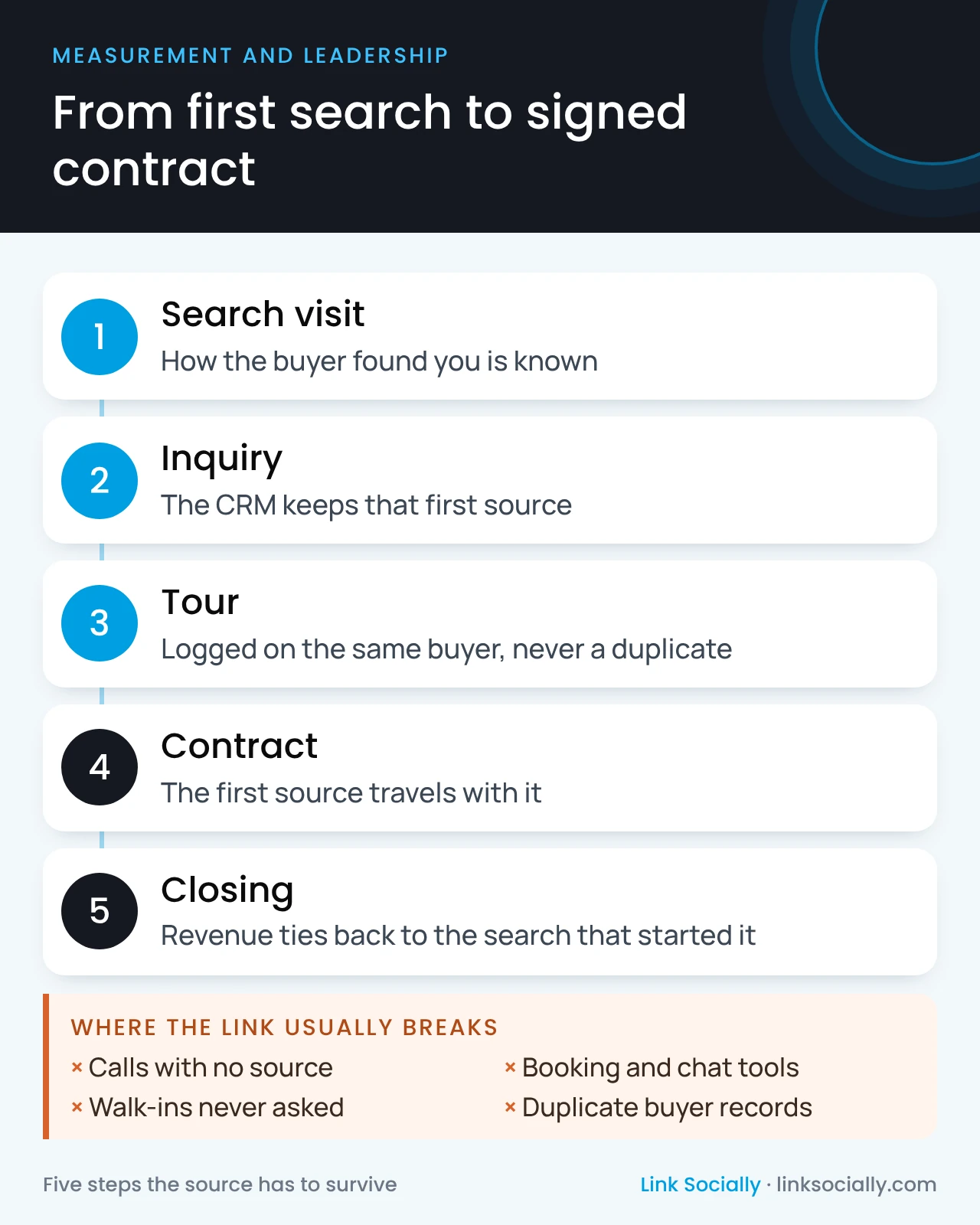
A home purchase moves through five steps, often over weeks or months, and the record of how the buyer found you has to survive every hand-off between marketing and sales.
- Search visit. The buyer finds a community page through a search.
- Inquiry. A form, a call, a chat or a booking. The CRM should keep how they found you.
- Tour. Logged against the same buyer, not a new record created at the sales center.
- Contract. Linked to that buyer, so the original source travels with it.
- Closing. The revenue can be tied back to the search that started it.
The link usually breaks in the same places: phone calls with no source attached, chat and booking tools that drop it, walk-ins nobody asks, and sales agents who create a second record for a buyer who already inquired online.
Three rules that close the gap
How the connection is built is a job for your web team, CRM administrator and agency. What makes their work hold together is three rules only leadership can set:
- Every inquiry records how the buyer first found you, whether it arrives by form, phone, chat, booking or a walk-in.
- That first source is never overwritten. Later visits can be recorded too, but the first one stays.
- Sales and marketing use one definition of an inquiry, a tour and a contract, so the numbers mean the same thing in both departments.
Make sure your privacy policy tells visitors what you collect, and collect only what the business will use.
Why most reports undercount organic search
Builders have long sales cycles, and that changes which channel gets the credit.
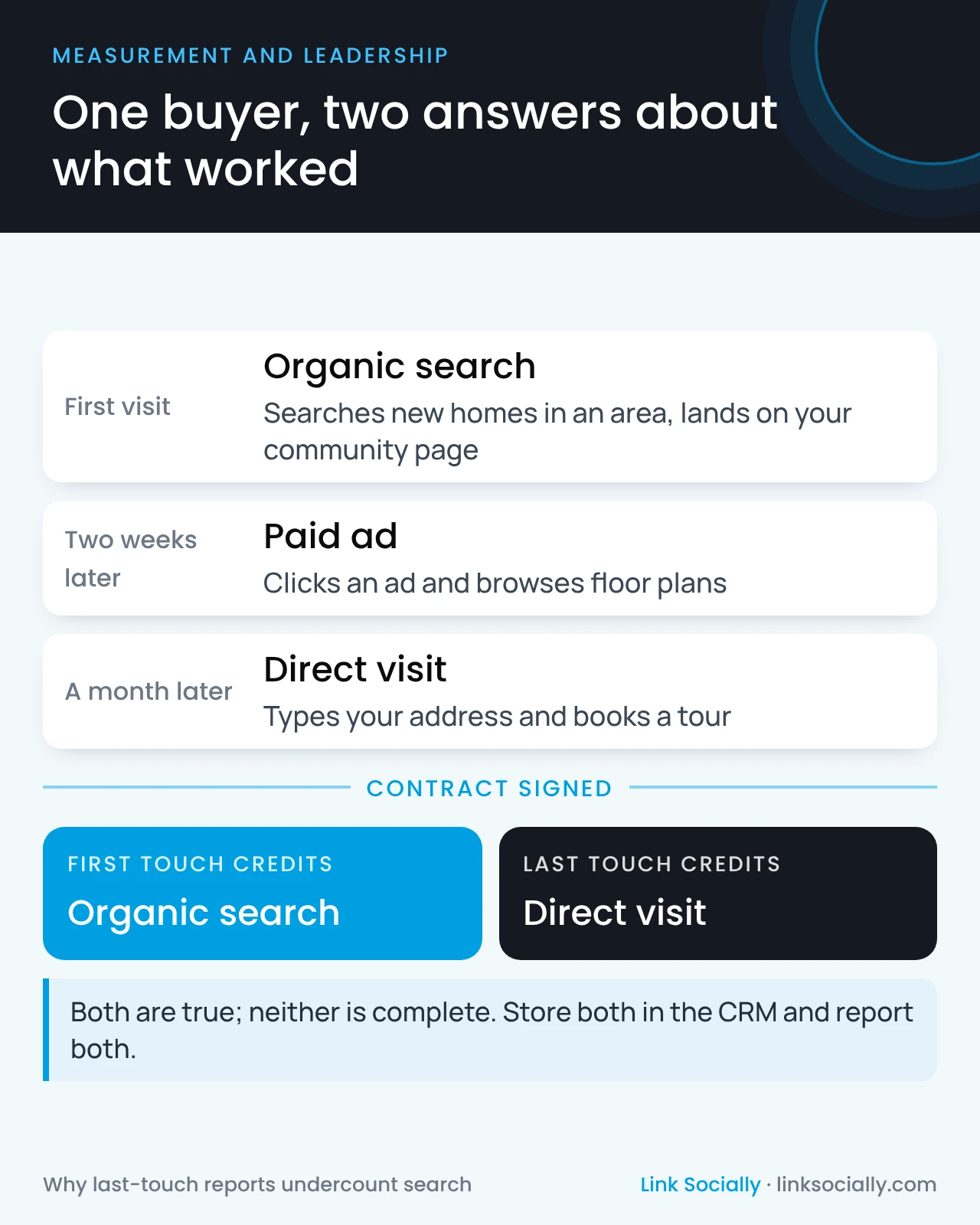
Picture a buyer who first searches for new homes in an area and lands on your community page. Two weeks later they click a paid ad. A month after that, they type your address into the browser and book a tour. A last-touch report credits the direct visit. A first-touch report credits the organic search that introduced you. Both are true; neither is complete.
Analytics tools also remember a buyer for a limited window, often shorter than a home purchase takes. Google Analytics, for example, looks back at most 90 days when it credits an inquiry to earlier visits, a setting it calls the lookback window. That is another reason the first source belongs in the CRM, where it lasts as long as the buyer’s record does. Ask for contracts by first touch and by last touch, and make budget decisions with both in view.
Report contracts by community and source
Once the data connects, the monthly report you see should change. Alongside rankings and traffic, ask for:
- Organic inquiries, tours and contracts by community, by first touch.
- How often inquiries become tours and tours become contracts, compared by source.
- How long buyers take from first visit to contract, by source.
- The share of contracts that began with a search, trended over time.
These are the numbers that let SEO compete fairly for budget, and they make forecasting honest. The guide on SEO forecasts and the sales pipeline shows how to use them in planning, and the forecasting case study shows what that looked like inside a national builder.
Questions to ask your team
Five questions will tell you how far you are from a report like that:
- How many of last quarter’s contracts started with a search? If we can’t say, where does the source get lost?
- Do phone and walk-in buyers get a source, or only web forms?
- Can a later visit overwrite how a buyer first found us?
- Do sales and marketing count inquiries, tours and contracts the same way?
- Do we report contracts by first touch as well as last touch?
Who owns the connection
The connection crosses departments, so ownership has to be explicit:
- Sales operations or the CRM administrator owns the buyer record and the rule that the first source is never overwritten.
- The web team or vendor owns the forms, call tracking and booking tools that pass the source in.
- The analytics lead or agency owns the report.
- The marketing leader owns the result, and agrees the shared definitions with sales leadership.
Leadership approves the three rules and a monthly review. With those in place, SEO is judged the way every other investment is, on what it produces. That is the premise of revenue-driven SEO, and it is what our SEO reporting and forecasting work is built to deliver.