
Growing Non-Branded Search for a National Home Builder
A national home builder ranked well for its own brand name but captured far less visibility from buyers searching by location, price, or home type. Restructuring community and floor plan architecture expanded the site’s ability to appear for non-branded demand.

The challenge: strong brand visibility, limited discovery
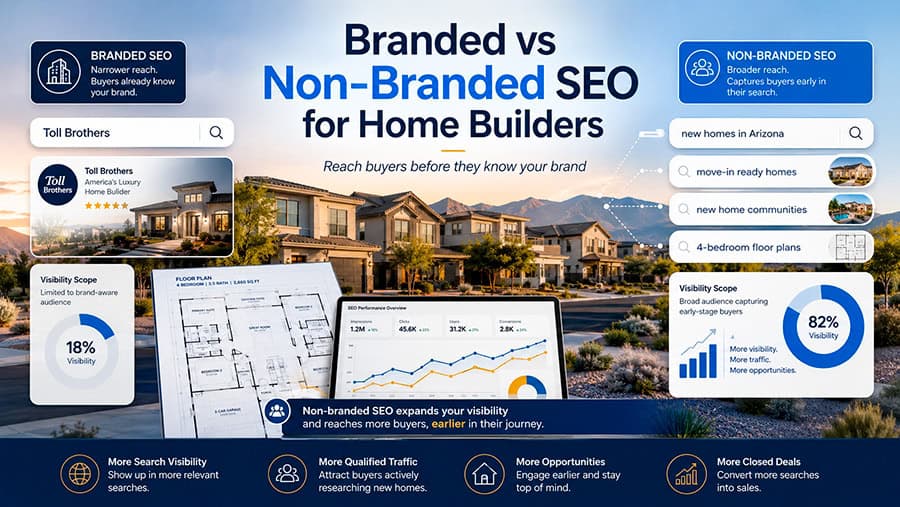
The builder was visible when people searched for its name, but branded performance did not reflect the full size of the opportunity. Buyers often begin with broader searches such as new homes in a specific city, homes under a certain price, or floor plans with a particular number of bedrooms. Those searches happen before a buyer has chosen a builder.
The website contained valuable communities and floor plans, but the relationship between those page types was not consistently clear. Some pages were optimized around internal naming conventions rather than the language buyers used in search. As a result, the site had relevant inventory but was not always presenting it through the strongest search entry points.
The approach: map demand to the right page type
The work began with keyword and market analysis focused on non-branded demand. Searches were grouped by location, home type, price range, bedroom count, community, and floor plan intent. The goal was not to place every keyword on every page. It was to determine which page should answer each type of question.
Community pages were positioned around location-based commercial intent. Floor plan pages were aligned with searches involving layout, size, bedrooms, bathrooms, and design features. Supporting content was evaluated based on whether it helped buyers understand the market or simply repeated terms already owned by a stronger commercial page.
Internal links were also reviewed so that communities, floor plans, inventory, and related resources reinforced one another. This created a clearer path for both users and search engines: broad location searches could lead to communities, while more specific design searches could lead to floor plan pages.
What changed
The site developed a more deliberate architecture for non-branded discovery. Instead of relying primarily on the builder’s name to generate qualified visits, the website could compete for searches made by buyers still comparing options.
The improvement was structural as much as editorial. Page titles, headings, internal links, and content priorities were aligned with the role each URL was expected to play. This reduced ambiguity and made it easier to expand coverage without creating unnecessary duplication.
Non-branded visibility also created a more useful measurement framework. Performance could be evaluated by market, community, page type, and search intent rather than by total organic traffic alone. That distinction matters because a rise in impressions is not enough if the visibility does not reach the markets or page types that support inquiries.
What home builders can learn
A builder does not need to wait for buyers to search for its name. The strongest opportunity often exists earlier in the decision process, when people are comparing locations, prices, layouts, and available communities.
Non-branded SEO works best when the website reflects those decisions. A community page should help someone evaluate where to live. A floor plan page should help someone evaluate how a home fits their needs. Supporting content should answer real questions without competing with the pages designed to generate action.
Our Non-Branded SEO Strategy for Home Builders
At Link Socially, we build non-branded SEO strategies around buyer search behavior, page intent, market-level visibility, and scalable website architecture.
The goal is simple:
Make sure the right pages rank for the right searches in the right markets.
1. We Separate Branded and Non-Branded Organic Performance
The first step is measurement clarity.
We review your organic visibility to determine how much traffic comes from branded searches and how much comes from non-branded discovery searches.
This helps answer:
- Are people finding you because they already know your brand?
- Are new buyers discovering you through category, city, and community searches?
- Which markets have the strongest non-branded opportunity?
- Which important terms are competitors winning?
- Which pages are underperforming despite strong buyer intent?
This separation helps leadership understand whether SEO is protecting existing demand or creating new demand.
2. We Identify Buyer Discovery Keywords by Market
Home builder SEO should not be evaluated only at the national level.
Different states, cities, suburbs, and communities have different search behavior and competitive conditions.
We identify non-branded opportunities across market-specific searches such as:
- New homes in [City].
- New construction homes in [City], [State].
- Move-in ready homes in [City].
- New home communities near [Area].
- Homes for sale near [School District].
- New homes near [Employment Center].
- [Bedroom Count] bedroom homes in [City].
- Floor plans in [Market].
- New homes near me.
This helps connect keyword strategy to actual buyer intent.
3. We Map Keywords to the Right Page Types
A common SEO mistake is trying to make every page rank for the same broad terms.
That creates cannibalization.
Instead, each page type needs a clear search purpose.
For example:
Page Type | SEO Purpose |
State Page | Broad discovery for statewide new home searches |
City Page | Local visibility for buyers comparing markets |
Community Page | Community-level evaluation and trust building |
Available Homes Page | Inventory discovery within a market or community |
Quick Move-In Page | Immediate purchase intent |
Floor Plans Page | Layout comparison and product evaluation |
Individual Floor Plan Page | Detailed plan-specific consideration |
Blog Content | Educational support for buyer questions and local discovery |
When each page has a clear role, search engines can better understand which URL should rank for each query.
4. We Reduce Keyword Cannibalization
Home builder websites often have many pages competing for similar terms.
A city page, community page, available homes page, quick move-in page, and blog post may all target variations of “new homes in [city].”
When that happens, rankings may fluctuate and authority may be split across multiple URLs.
Link Socially reviews cannibalization across:
- Titles.
- Meta descriptions.
- H1s.
- H2s.
- URL structure.
- Body copy.
- Internal links.
- Structured data.
- Template-level keyword targeting.
- Blog-to-service page overlap.
Then we clarify which page should own which intent.
5. We Improve On-Page Signals for Non-Branded Visibility
Non-branded SEO requires more than adding keywords.
Each page needs to clearly communicate relevance, location, product type, buyer intent, and next steps.
We optimize:
- Page titles.
- Meta descriptions.
- Headings.
- Introductory copy.
- Community descriptions.
- Local relevance signals.
- Internal links.
- FAQ sections.
- Image alt text.
- Schema direction.
- Calls to action.
- Conversion paths.
The goal is to help buyers and search engines understand exactly why a page is relevant.
6. We Connect SEO to Paid Media Efficiency
Non-branded SEO can also reveal paid media inefficiencies.
If your website already ranks organically for valuable searches, but paid campaigns are also bidding on those same terms, paid media may be taking credit for demand that organic search helped create.
This does not mean paid media should stop.
It means SEO and paid search should be measured together.
A smarter strategy helps determine:
- Which terms need paid support.
- Which terms organic search can already capture.
- Which branded terms are inflating paid performance.
- Which non-branded terms deserve investment.
- Where paid search is expanding reach.
- Where paid search may be duplicating organic visibility.
This can help home builders reduce wasted spend and improve total search efficiency.
Case-Based Results From a Non-Branded SEO Shift
In one large home builder SEO program, the initial organic visibility was heavily tied to branded searches, community names, floor plan names, and other terms already connected to the company.
The brand had limited meaningful presence for broader discovery searches such as “new homes in [city],” “homes for sale in [city],” or “new construction homes near me.”
The strategy shifted toward market-level SEO visibility, non-branded keyword growth, search intent alignment, cannibalization reduction, technical cleanup, structured data, image optimization, and stronger page architecture.
The work supported:
- Triple-digit organic traffic growth.
- More than 1,000 new non-branded keyword rankings.
- A major reduction in keyword cannibalization.
- Thousands of technical SEO issues resolved.
- Tens of thousands of images optimized.
- Stronger engagement on high-value product and inventory pages.
- Better visibility across AI-driven search environments.
The most important outcome was not just the numbers.
The website became better positioned to reach buyers who did not already know the brand.
That is the purpose of non-branded SEO.
Frequently Asked Questions About Non-Branded SEO for Home Builders
What is non-branded SEO for home builders?
Non-branded SEO targets searches that do not include the builder’s name, such as new homes in a city, homes under a specific price, or three-bedroom floor plans.
Why is non-branded traffic important?
It reaches buyers earlier, before they have selected a builder. That creates an opportunity to enter the consideration set rather than only capture existing brand demand.
Which pages usually support non-branded visibility?
Community, city, floor plan, inventory, and carefully selected educational pages can all contribute when each has a distinct search purpose.
Can paid search overlap with branded and non-branded SEO?
Map search intent to page types first, then define clear ownership for locations, communities, floor plans, inventory, and supporting topics.
Should every community target the same keywords?
No. Each community should reflect its actual location, product, price range, amenities, and buyer intent instead of using identical copy across the site.
Does non-branded SEO help AI search visibility?
Yes. Non-branded SEO can improve AI search visibility by making your website’s entities, markets, home types, communities, and buyer intent signals clearer for search engines and answer engines.

Led by the strategist behind the growth
Cristobal Varela led this work personally as in-house SEO manager at the national home builder documented here. See why this matters for a builder specifically on the keyword and market intelligence service page.
Next step
Related service: Keyword & Market Intelligence
Non-branded growth starts with understanding how buyers search before they know your brand. Keyword and Market Intelligence helps identify that demand, map it to the right page types, and prioritize the opportunities most likely to support qualified discovery.