
Non-Branded SEO for Home Builders

Help buyers discover your communities before they already know your brand
Branded search is valuable, but it should not be the only way buyers find your home building company.
When someone searches for your company name, community name, model name, or branded floor plan, they already know something about you. They may have seen an ad, driven past your signage, received a referral, visited a model home, or returned after a previous website visit.
That traffic matters.
But branded search usually captures demand that already exists.
Non-branded SEO helps create new discovery.
For home builders, that means showing up when buyers search for terms like “new homes in Phoenix,” “move-in ready homes near me,” “new construction homes in Austin,” “four-bedroom homes in Mesa,” or “new home communities near schools.”
At Link Socially, we help home builders move beyond branded visibility and build stronger organic reach across the searches buyers use before they know which builder to choose.
Why Branded Search Alone Can Limit Home Builder Growth
A home builder can appear healthy in SEO reports while still missing major organic growth opportunities.
That happens when most organic visibility comes from branded terms.
Branded search may include:
- Your company name.
- Community names.
- Floor plan names.
- Model home names.
- Development names.
- Branded campaign terms.
- Searches from people who already know your business.
This traffic can convert well because the buyer is already familiar with your brand.
But it does not necessarily mean your website is reaching new buyers.
If your organic traffic depends mostly on people who already know what to search for, your SEO strategy may be acting more like a safety net than a growth engine.
It is protecting existing demand, not expanding market visibility.
What Non-Branded SEO Means for Home Builders
Non-branded SEO helps your website appear when buyers search for what they need, not who you are.
For home builders, non-branded searches may include:
- New homes in a specific city.
- New construction homes near a major metro area.
- Move-in ready homes in a local market.
- Homes for sale near schools or job centers.
- New home communities in a suburb.
- Four-bedroom homes in a specific city.
- Floor plans for growing families.
- New homes near highways, shopping, or employment centers.
- Custom home builders in a local market.
- Best neighborhoods for new construction homes.
These searches represent buyers who are still exploring options.
They may not have a preferred builder yet. They may not know your company name. They may be comparing cities, communities, layouts, commute times, price ranges, and availability.
If your competitors appear and you do not, they get the first opportunity to shape the buyer’s expectations.
That is why non-branded SEO is not just an SEO tactic.
It is a visibility strategy for growth.
The Business Risk of Relying Too Heavily on Branded SEO
If your company ranks only for branded keywords, your reports may look stronger than your actual market position.
You may see organic traffic, leads, and conversions, but miss the more important question:
Are buyers finding us before they already know who we are?
For home builders, this question matters because one missed buyer can represent a high-value opportunity.
A buyer searching for “new homes in [city]” may be actively comparing communities. If your brand is not visible during that search, the buyer may visit a competitor’s website, schedule a tour, download a brochure, or speak with a sales consultant before discovering your homes.
By the time your brand appears later in the journey, the competitor may already feel like the safer choice.
Non-branded SEO helps your company compete earlier.
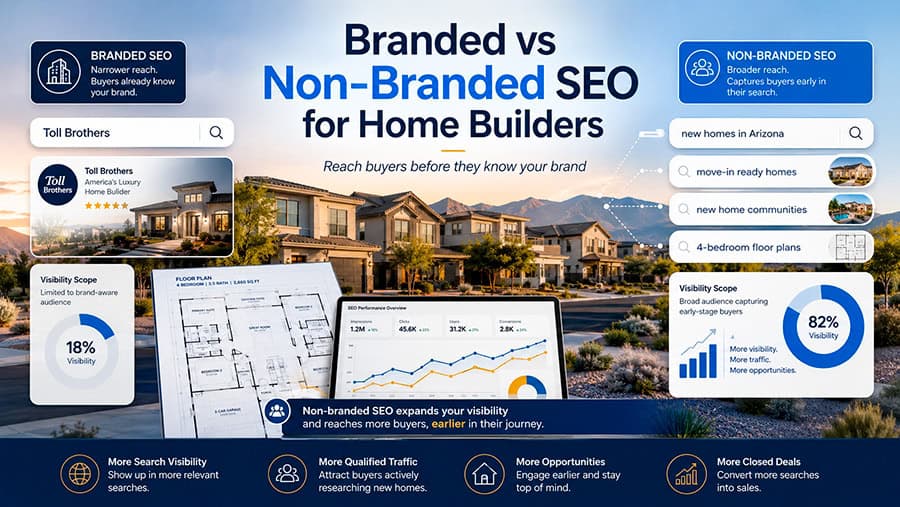
A Real Visibility Problem: The Buyer Who Never Finds You
One of the clearest ways to understand non-branded SEO is to think like a buyer.
A buyer may search online, compare builders, explore neighborhoods, visit model homes, and drive through communities. They may find several competitors located in the same market where your company already builds.
But if your website does not appear for non-branded discovery searches, that buyer may never know you were an option.
This can happen even when your communities are physically close to competitors.
The problem is not market presence.
The problem is search visibility.
If buyers are searching for homes in cities where you already build, your website needs a path to be found without requiring them to know your name first.
Branded SEO Protects Demand. Non-Branded SEO Creates Opportunity.
Branded and non-branded SEO serve different purposes.
Branded SEO Helps Buyers Return to You
Branded search is important because it helps people who already know your company find you quickly.
This includes:
- Returning website visitors.
- Referrals.
- Past customers.
- Buyers who saw your signage.
- Buyers who clicked an ad earlier.
- People searching for a specific community or model.
Your brand should be easy to find, easy to understand, and easy to trust.
Non-Branded SEO Helps New Buyers Discover You
Non-branded SEO helps you appear when a buyer describes their need.
This includes searches based on:
- Location.
- Home type.
- Community features.
- Move-in timeline.
- Floor plan needs.
- Lifestyle priorities.
- School proximity.
- Commute access.
- Budget range.
- Comparison research.
This is where organic search becomes a true growth channel.
It allows your home builder brand to enter the decision-making process before the buyer has narrowed the field.
Our Non-Branded SEO Strategy for Home Builders
At Link Socially, we build non-branded SEO strategies around buyer search behavior, page intent, market-level visibility, and scalable website architecture.
The goal is simple:
Make sure the right pages rank for the right searches in the right markets.
1. We Separate Branded and Non-Branded Organic Performance
The first step is measurement clarity.
We review your organic visibility to determine how much traffic comes from branded searches and how much comes from non-branded discovery searches.
This helps answer:
- Are people finding you because they already know your brand?
- Are new buyers discovering you through category, city, and community searches?
- Which markets have the strongest non-branded opportunity?
- Which important terms are competitors winning?
- Which pages are underperforming despite strong buyer intent?
This separation helps leadership understand whether SEO is protecting existing demand or creating new demand.
2. We Identify Buyer Discovery Keywords by Market
Home builder SEO should not be evaluated only at the national level.
Different states, cities, suburbs, and communities have different search behavior and competitive conditions.
We identify non-branded opportunities across market-specific searches such as:
- New homes in [City].
- New construction homes in [City], [State].
- Move-in ready homes in [City].
- New home communities near [Area].
- Homes for sale near [School District].
- New homes near [Employment Center].
- [Bedroom Count] bedroom homes in [City].
- Floor plans in [Market].
- New homes near me.
This helps connect keyword strategy to actual buyer intent.
3. We Map Keywords to the Right Page Types
A common SEO mistake is trying to make every page rank for the same broad terms.
That creates cannibalization.
Instead, each page type needs a clear search purpose.
For example:
Page Type | SEO Purpose |
State Page | Broad discovery for statewide new home searches |
City Page | Local visibility for buyers comparing markets |
Community Page | Community-level evaluation and trust building |
Available Homes Page | Inventory discovery within a market or community |
Quick Move-In Page | Immediate purchase intent |
Floor Plans Page | Layout comparison and product evaluation |
Individual Floor Plan Page | Detailed plan-specific consideration |
Blog Content | Educational support for buyer questions and local discovery |
When each page has a clear role, search engines can better understand which URL should rank for each query.
4. We Reduce Keyword Cannibalization
Home builder websites often have many pages competing for similar terms.
A city page, community page, available homes page, quick move-in page, and blog post may all target variations of “new homes in [city].”
When that happens, rankings may fluctuate and authority may be split across multiple URLs.
Link Socially reviews cannibalization across:
- Titles.
- Meta descriptions.
- H1s.
- H2s.
- URL structure.
- Body copy.
- Internal links.
- Structured data.
- Template-level keyword targeting.
- Blog-to-service page overlap.
Then we clarify which page should own which intent.
5. We Improve On-Page Signals for Non-Branded Visibility
Non-branded SEO requires more than adding keywords.
Each page needs to clearly communicate relevance, location, product type, buyer intent, and next steps.
We optimize:
- Page titles.
- Meta descriptions.
- Headings.
- Introductory copy.
- Community descriptions.
- Local relevance signals.
- Internal links.
- FAQ sections.
- Image alt text.
- Schema direction.
- Calls to action.
- Conversion paths.
The goal is to help buyers and search engines understand exactly why a page is relevant.
6. We Connect SEO to Paid Media Efficiency
Non-branded SEO can also reveal paid media inefficiencies.
If your website already ranks organically for valuable searches, but paid campaigns are also bidding on those same terms, paid media may be taking credit for demand that organic search helped create.
This does not mean paid media should stop.
It means SEO and paid search should be measured together.
A smarter strategy helps determine:
- Which terms need paid support.
- Which terms organic search can already capture.
- Which branded terms are inflating paid performance.
- Which non-branded terms deserve investment.
- Where paid search is expanding reach.
- Where paid search may be duplicating organic visibility.
This can help home builders reduce wasted spend and improve total search efficiency.
What Happens When Home Builders Power Up Non-Branded SEO
A stronger non-branded SEO strategy can improve visibility across the full buyer journey.
It can help your company:
- Reach buyers earlier in their research.
- Compete in cities where you already build.
- Reduce dependency on branded demand.
- Strengthen visibility for new communities.
- Improve performance of inventory and quick move-in pages.
- Support market expansion.
- Build authority beyond company-name searches.
- Improve the quality of organic traffic.
- Align SEO, paid media, and sales expectations.
- Create a more measurable organic growth engine.
The real goal is not just more traffic.
The goal is to increase qualified discovery from buyers who are actively searching for what you offer.
Case-Based Results From a Non-Branded SEO Shift
In one large home builder SEO program, the initial organic visibility was heavily tied to branded searches, community names, floor plan names, and other terms already connected to the company.
The brand had limited meaningful presence for broader discovery searches such as “new homes in [city],” “homes for sale in [city],” or “new construction homes near me.”
The strategy shifted toward market-level SEO visibility, non-branded keyword growth, search intent alignment, cannibalization reduction, technical cleanup, structured data, image optimization, and stronger page architecture.
The work supported:
- Triple-digit organic traffic growth.
- More than 1,000 new non-branded keyword rankings.
- A major reduction in keyword cannibalization.
- Thousands of technical SEO issues resolved.
- Tens of thousands of images optimized.
- Stronger engagement on high-value product and inventory pages.
- Better visibility across AI-driven search environments.
The most important outcome was not just the numbers.
The website became better positioned to reach buyers who did not already know the brand.
That is the purpose of non-branded SEO.
Non-Branded SEO and AI Search Visibility
AI-driven search systems depend on clear signals.
If your website only performs for branded searches, answer engines may understand your company name but still struggle to connect your brand to broader buyer needs.
A strong non-branded SEO strategy improves how your website communicates:
- What types of homes you build.
- Where you build.
- Which communities are available.
- Which homes are move-in ready.
- Which floor plans match specific buyer needs.
- Which cities and suburbs you serve.
- Which buyer questions your website answers.
- Which pages should be trusted for each search intent.
This supports SEO, AEO, and GEO by making your content easier for search engines and AI systems to interpret, retrieve, and recommend.
How Executives Should Evaluate Branded vs Non-Branded SEO
Executives do not need to know every technical SEO detail.
But they should know whether SEO is creating new discovery or only capturing existing demand.
Questions to Ask Your SEO Team
- Are we separating branded and non-branded organic performance?
- Which non-branded keywords are driving qualified visibility?
- Are we ranking for searches buyers use before they know our brand?
- Which markets have the strongest non-branded opportunity?
- Which pages should rank for each type of buyer intent?
- Are multiple pages competing against each other?
- Are paid campaigns overlapping with organic visibility?
- Are we measuring SEO by market, product type, and buyer journey stage?
- Are recommendations being implemented, tested, and measured?
- Is organic growth tied to qualified leads or only traffic?
These questions help shift the SEO conversation from rankings to business impact.
When Your Home Builder Brand Needs a Non-Branded SEO Strategy
You may need a stronger non-branded SEO strategy if:
- Most of your organic traffic comes from your company name.
- Competitors appear for city-level new home searches and you do not.
- Your communities are active in a market but not visible organically.
- Your paid ads drive traffic for searches where you should rank organically.
- You have many similar pages competing for the same terms.
- Your reports do not separate branded and non-branded performance.
- Your local pages are weak or underdeveloped.
- Your inventory pages receive traffic but not enough qualified engagement.
- Your SEO reporting looks positive but market discovery feels limited.
- You are expanding into new regions and need organic visibility.
If buyers are searching for what you offer, your brand needs a path to be found.
Why Work With Link Socially
Link Socially helps home builders build SEO strategies that go beyond branded visibility.
We connect technical SEO, content strategy, search intent, market-level reporting, AEO readiness, and conversion-focused optimization into one clear organic growth framework.
Our non-branded SEO process helps home builders understand where they are currently visible, where they are missing buyer discovery, and what needs to change to compete in organic search.
Our Non-Branded SEO Services for Home Builders Include:
- Branded vs non-branded SEO analysis.
- Market-level organic visibility review.
- Non-branded keyword opportunity mapping.
- Page intent strategy.
- Content cannibalization analysis.
- City and community page optimization.
- Quick move-in and inventory page optimization.
- Floor plan SEO strategy.
- Internal linking recommendations.
- Paid search overlap review.
- Technical SEO prioritization.
- AEO and AI search readiness.
- Executive SEO reporting.
Frequently Asked Questions About Non-Branded SEO for Home Builders
What is non-branded SEO for home builders?
Non-branded SEO for home builders is the strategy of ranking for searches that describe what buyers want, such as “new homes in Phoenix,” “move-in ready homes near me,” or “new construction homes in Austin,” instead of only ranking for the builder’s company name or community names.
What is the difference between branded and non-branded search?
Branded search comes from people who already know your company, community, or product name. Non-branded search comes from people searching by need, location, home type, feature, or buying stage before they know which builder they want to choose.
Why is branded SEO not enough for home builders?
Branded SEO is important, but it usually captures existing demand. Home builders need non-branded SEO to reach buyers earlier in the journey, especially when those buyers are comparing cities, communities, floor plans, and move-in ready homes.
How can non-branded SEO generate more qualified home buyer traffic?
Non-branded SEO can generate qualified traffic by helping your pages appear for searches that reflect active buyer intent, such as location-based new home searches, quick move-in searches, floor plan searches, and community comparison searches.
Can paid search overlap with branded and non-branded SEO?
Yes. Paid search can overlap with organic visibility when ads appear for keywords where your website already ranks. This can make paid media look stronger while hiding the true contribution of organic search.
How do you know if your home builder website relies too much on branded traffic?
Your website may rely too much on branded traffic if most organic visits come from company names, community names, model names, or branded terms, while non-branded searches such as “new homes in [city]” or “move-in ready homes near me” produce little visibility.
What pages should support non-branded SEO for home builders?
Important pages for non-branded SEO include state pages, city pages, community pages, available homes pages, quick move-in pages, floor plan pages, individual plan pages, and educational blog content that answers buyer questions.
Does non-branded SEO help AI search visibility?
Yes. Non-branded SEO can improve AI search visibility by making your website’s entities, markets, home types, communities, and buyer intent signals clearer for search engines and answer engines.

Who guides the strategy behind Non-Branded SEO
Cristobal Varela guides this strategy through hands-on SEO work with home builder websites, focusing on page profiling, search intent alignment, content architecture, and technical SEO. This approach helps identify where community, floor plan, and inventory pages compete with each other so the site can send clearer ranking signals to Google.
Next step
Request a Non-Branded SEO Opportunity Audit
If your home builder website depends mostly on branded search, you may be missing buyers who are actively searching for homes in the markets where you already build.
Link Socially can help you identify where your brand is visible, where competitors are winning discovery, and how to build a stronger non-branded SEO foundation.