
The Hidden $136K/Month Mistake: How Paid Media Overlap Is Suppressing SEO Results
Paying for SEO and Paid Media should strengthen search visibility, not create internal competition. When those channels operate in silos, overlap can quietly waste budget and make SEO look weaker than it really is.

Why SEO appeared to be underperforming
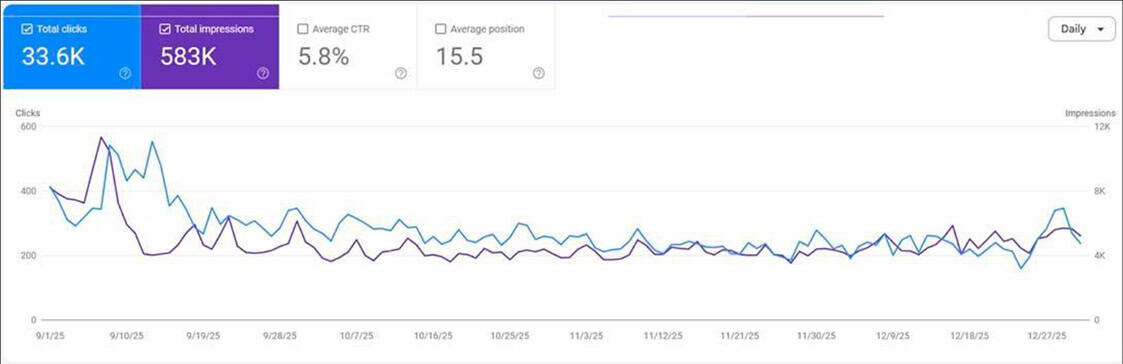
By Q3 2025, the numbers made it look like SEO was underperforming. Clicks and impressions were down year after year, even though average position and click-through rate had improved across the same three-month period. Leadership had a fair question: if SEO was getting stronger, why were the top-line numbers moving in the wrong direction?
Initial data suggested channel conflict, but pausing Paid Media carries understandable risk for any builder investing heavily in search visibility. We waited for a natural window to test the hypothesis safely. Then, during one dark week in early September 2025, the truth surfaced: organic performance increased by 65%.
For a home builder competing across multiple markets and buyer stages, that kind of lift does not happen by accident. It revealed that Paid Media was not simply supporting visibility. In overlapping areas, it was limiting the organic growth SEO was already beginning to earn.
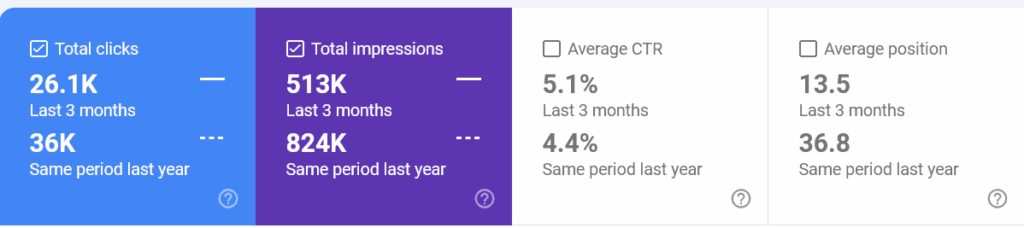
Caption: At first glance, the drop in clicks and impressions suggested SEO was losing momentum. But stronger average position and click-through rate told a different story.
And the graph was only part of the problem. With roughly $210,000 per month invested in Paid Media, an estimated 65% overlap represented as much as $136,500 in wasted budget every month. That spending could have been redirected toward areas where SEO was still developing or toward entirely new growth opportunities.
This is exactly where senior SEO strategy makes the difference. Anyone can report declining clicks. Not everyone can identify when SEO is being constrained by channel overlap, distorted attribution, and a search strategy working against itself.
Why the top-line numbers were misleadingWhy the top-line numbers were misleading
Clicks and impressions were down, but that did not automatically mean SEO quality was declining. In the same three-month year-over-year comparison, average position improved from 36.8 to 13.5 and click-through rate improved from 4.4% to 5.1%. Those are not the signals of a channel losing relevance. They are the signals of stronger alignment between rankings, search intent, and user engagement.
Metric | Q3 2024 | Q3 2025 | What it suggested |
Avg. Position | 36.8 | 13.5 | Stronger rankings |
CTR | 4.4% | 5.1% | Better engagement |
Clicks | 36K | 26.1K | Looked worse on the surface |
Impressions | 824K | 513K | Looked worse on the surface |
The problem was not the numbers themselves. The problem was how they were being interpreted. Clicks and impressions are easy to spot on a dashboard, but on their own they do not explain whether SEO is weakening, becoming more efficient, or being limited by forces outside the organic channel.
In this case, the surface-level decline was real, but the deeper performance signals pointed somewhere else. SEO was not simply shrinking. It was being masked.
How paid media overlap suppressed organic opportunity
The builder was investing in both SEO and Paid Media with the expectation that both channels would contribute to growth. In theory, which should have expanded total search coverage. In practice, the lack of coordination created overlap around the same demand. .
Paid Media was capturing visibility on search terms where SEO already had relevance or was beginning to gain traction. Instead of expanding total search presence efficiently, the business was paying to compete against its own organic opportunity. That overlap reduced organic click share, distorted performance perception, and made SEO appear weaker than it actually was.
This is one of the most expensive mistakes in search marketing. A company funds both channels expecting compounded growth, but when those channels operate in silos, one starts masking the value of the other. The result is wasted spending. It is weaker decision-making.
What one dark week revealed
The clearest proof came when Paid Media went dark for one week. Without paid campaigns absorbing overlapping search demand, organic performance responded immediately. SEO increased by 65%.
That moment changed the conversation. What had looked like weak organic growth was actually a distorted performance picture shaped by channel overlap. Once Paid Media stepped back, SEO had room to perform more honestly.
The increase did not create the opportunity. It exposed the opportunity that had already been there.
See if your channels are overlapping
What this meant for search strategyWhat this meant for search strategy
The lesson was not that Paid Media should be removed. Paid Media still plays an important role in speed, testing, demand capture, and short-term visibility. The real issue was funding both channels without enough alignment around where each should lead, where each should support, and where overlap was becoming unnecessarily expensive.
A stronger search strategy requires evaluating SEO and Paid Media together, especially on high-intent queries. Some search terms are worth protecting with paid campaigns. Others should gradually shift toward organic ownership as SEO matures. Without that discipline, companies continue investing in both channels while misreading the true return of one of them.

Protect bottom-funnel, high-intent queries with paid for speed and control.
Allow mid- and upper-funnel terms to shift toward organic ownership as rankings strengthen.
Review overlaps regularly so budget can be redirected from cannibalized areas into new opportunity gaps.
Evaluate both channels together, not in silos, to understand total search performance.
This case made one thing clear: the business was not just paying for traffic. It was paying twice to compete for search demand that should have been managed more strategically.
Key takeaway for leadership

- The most expensive SEO problems are not always technical. In this case, the real issue was internal overlap between Paid Media and SEO, which distorted performance and wasted budget.
- Top-line numbers can hide real organic progress. Clicks and impressions were down, but average position improved from 36.8 to 13.5 and click-through rate improved from 4.4% to 5.1%.
- Channel silos can make SEO look weaker than it is. When Paid Media and SEO compete for the same demand without coordination, leadership may underestimate organic performance.
- A temporary disruption exposed the truth. When Paid Media went dark for one week, SEO increased by 65%, revealing how much organic opportunity had been suppressed by overlap.
- Wasted spending changes the conversation. With roughly $210,000 per month invested in Paid Media, a 65% overlap represented as much as $136,500 in wasted budget each month.
- Senior SEO strategy matters. Surface-level reporting can point teams toward the wrong conclusion. Experienced SEO analysis helps separate weak performance from distorted reporting.
Next step
Book a free 30-minute strategic call
If your business is investing in both SEO and Paid Media, but organic performance still feels unclear, the problem may not be SEO alone. It may be the overlap between channels. In a free 30-minute strategic call, we can review where paid and organic search may be competing, where budget may be leaking, and whether your search strategy is aligned for stronger long-term growth.