
The community’s name isn’t yours
In a master-planned community, the name buyers know belongs to the developer. Signs, billboards, news coverage and word of mouth all point to that name, so that is what buyers search for. The developer’s website, as the official source, usually appears first. Listing portals and local news follow. Your own page is one of several builder pages trying to be found for the same name.
That changes the job. In a standalone community, your page should win the search for the community’s name. In a master-planned community, the realistic goal is to be easy to find from wherever the buyer starts: the developer’s site, the portals, AI assistants and the more specific searches buyers make once they know the community.
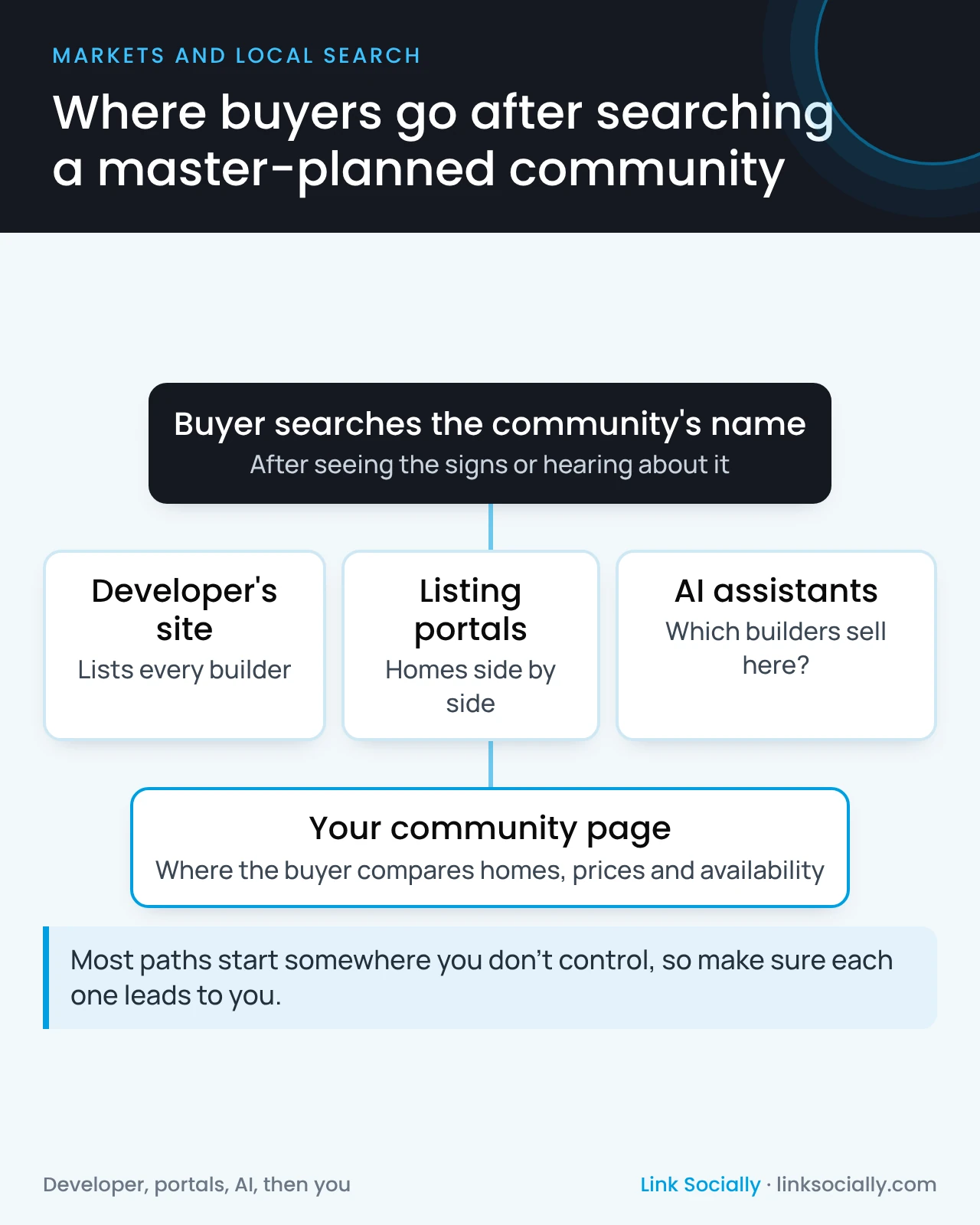
Where buyers go when they search the community’s name
Follow a buyer who has just driven past the entrance and searched for the community.
- The developer’s site lists the builders and neighborhoods. How your listing looks there, and whether it links to you, shapes whether you make the buyer’s shortlist.
- Listing portals show homes from every builder in the community, side by side.
- AI assistants answer questions such as which builders sell in the community, drawing on the developer’s site, portals and builder pages.
- Your community page wins when the buyer is ready to compare homes, prices and availability.
Treat the developer as a partner in search
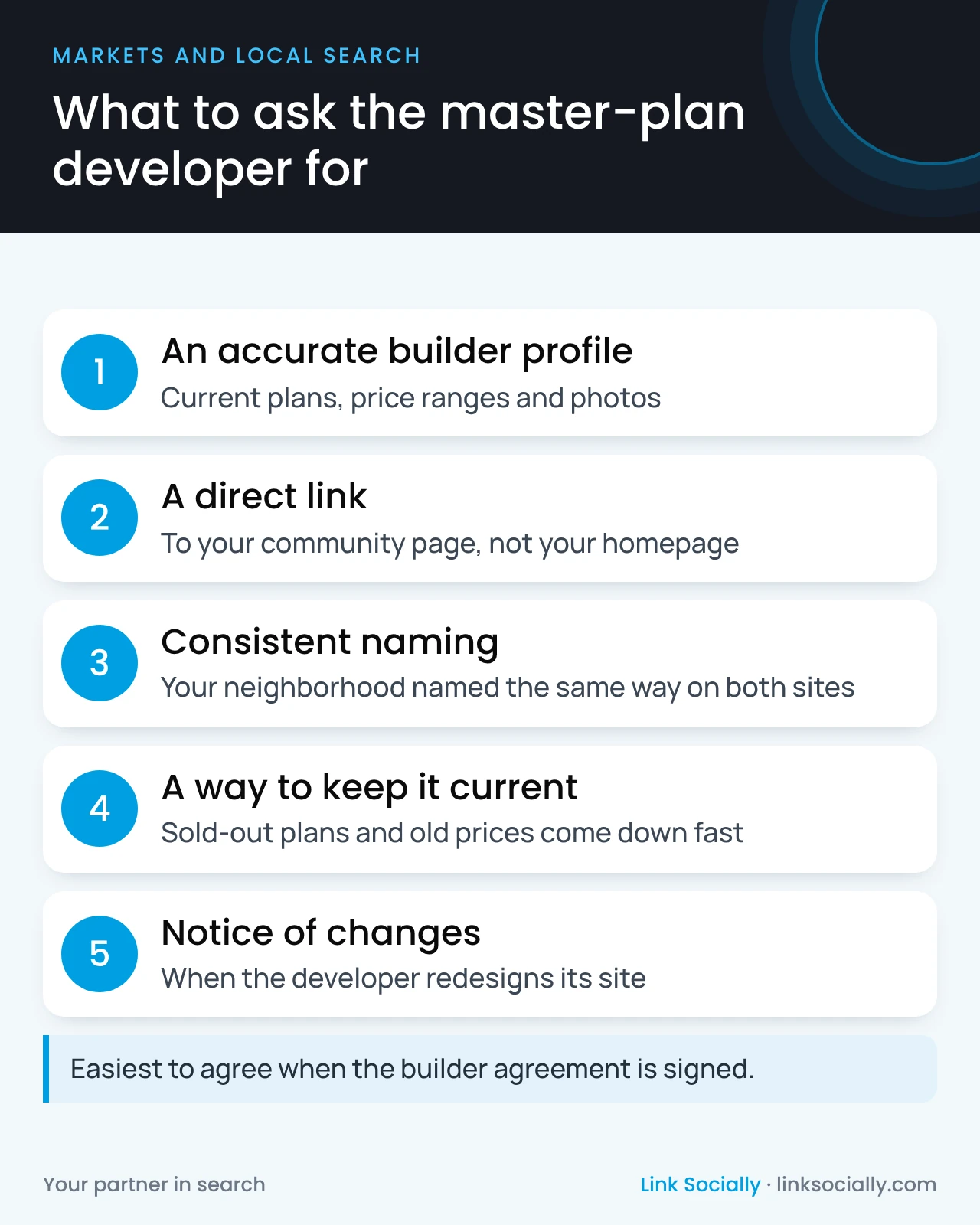
Your relationship with the developer is a search asset, and the best time to shape it is when the builder agreement is negotiated. Ask for:
- An accurate builder profile on the developer’s site, with your current plans, price ranges and photos.
- A direct link from that profile to your own community page, not to your homepage.
- Consistent naming for your neighborhood, used the same way on both sites.
- A way to keep it current, so sold-out plans and old prices come down quickly.
- Notice of changes when the developer redesigns its site or changes its builder pages.
Each of these confirms to search engines and AI assistants that you build in that community, which is part of what entity and authority engineering works on.
What a stale developer listing costs
Because so many buyers start on the developer’s site, an out-of-date listing there does real damage. Old price ranges send buyers away before they ever see your homes. Sold-out plans make you look like you have nothing left. A broken or missing link to your page means the buyer clicks the next builder on the list instead. And because AI assistants read the developer’s site when asked which builders sell in the community, the same stale details show up in their answers too.
None of this is visible in your own analytics, which is why someone on your team should check the developer’s builder page every month, the same way they check your own.
Win the searches that are specific to you
The developer’s site speaks for every builder. Your page should answer the questions only you can answer: your neighborhood’s name, the home types and sizes you build there, your prices, your homes available now and what makes your homes different from the builder next door.
Those specific searches are where buyers are closest to choosing. A buyer searching for single-story homes in your neighborhood, or for homes ready to move into inside the community, is comparing builders, and a clear, current page wins that comparison. Say plainly on your page that your neighborhood is inside the master-planned community, so buyers and AI assistants connect the two. Then make your homes the focus.
Questions to ask your team
- When a buyer searches for the master-planned community’s name, where do we appear, and where do our competitors appear?
- Is our profile on the developer’s site accurate, current and linked to our community page?
- What do AI assistants say when asked which builders sell in the community?
- Which searches specific to our neighborhood or our homes do we win today?
- Who manages the relationship with the developer’s marketing team?
Who owns it
- Division leadership or land partnerships own the developer relationship and what is agreed in the builder agreement.
- Division marketing keeps the developer listing, portals and your page current.
- The SEO lead or agency tracks where you appear for the community’s name and for your specific searches, including AI answers.
The work fits within local SEO for each community. If the master-planned community is in a market you are entering for the first time, start with SEO before your first community opens.