
Why community pages carry most of your local demand
Buyers search by place long before they search by brand. They look for new homes in a city, the name of a community they drove past, or new construction near an employer or school district. For a builder, the page that should answer those searches is the community page: it is the one page that combines a location, the homes for sale there and a way to visit.
That makes it the page your non-branded search growth depends on, the page your sales office’s Google profile should send buyers to, and the page AI assistants read when a buyer asks about the community by name. When it is thin, every one of those paths ends somewhere weaker: a listing portal that charges you for the lead, a competitor, or a generic city page on your own site.
Check your own pages in five minutes
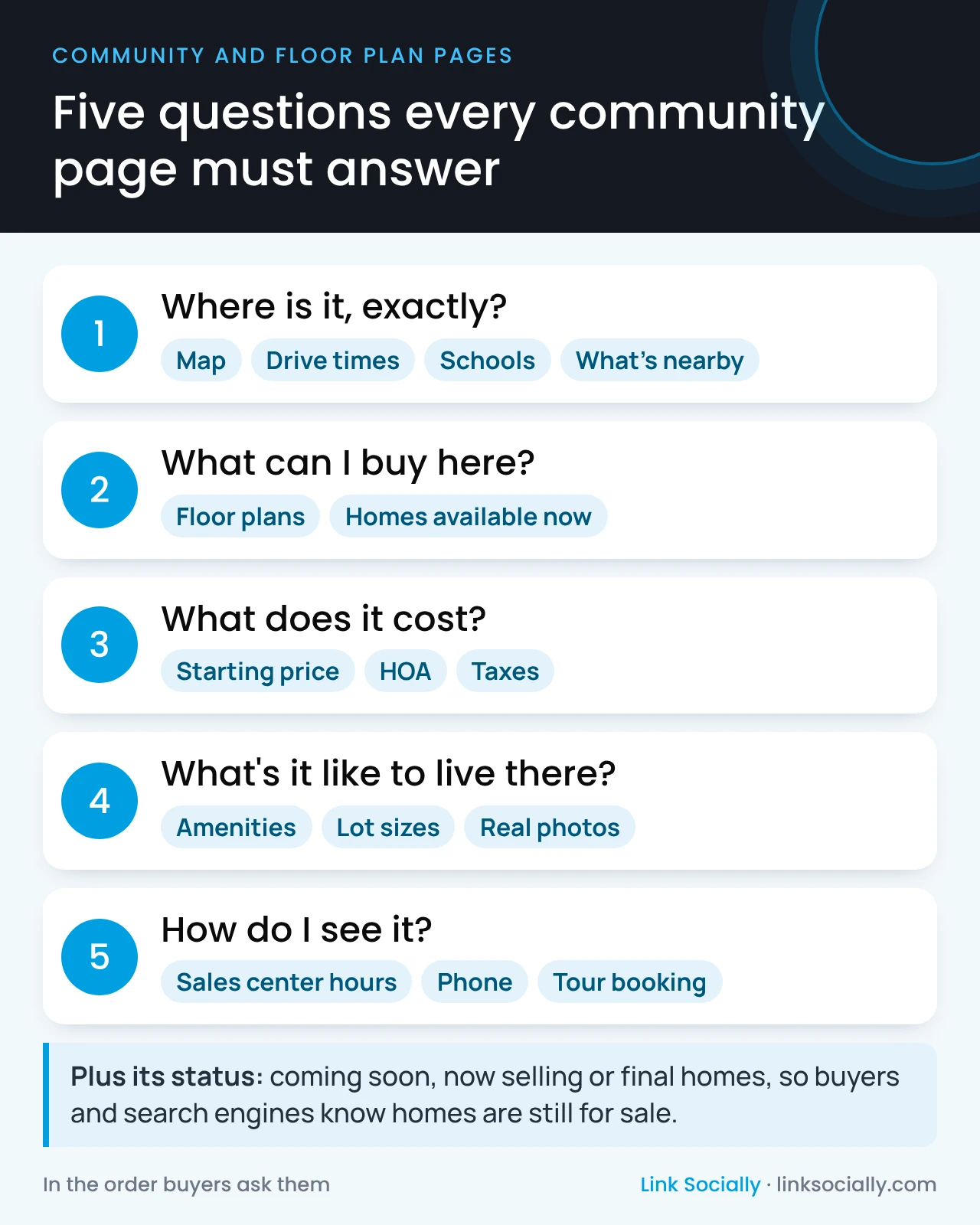
You don’t need a tool to judge a community page. Open three of yours on your phone and see whether each one answers the five questions a buyer brings, roughly in this order.
- Where is it, exactly? A map, drive times to major employers and the schools that serve it.
- What can I buy here? The floor plans offered in this community and the homes available now.
- What does it cost? A current starting price or range, and the HOA and tax details buyers will ask about anyway.
- What is it like to live there? Amenities, lot sizes and real photos of the community, not stock images.
- How do I see it? Sales center hours, a phone number and a way to book a tour.
If you had to scroll, search or guess to answer any of them, so do your buyers.
Template pages are the most common reason community pages underperform
Most builder sites produce community pages from one template, which is efficient and sensible. The problem starts when the template supplies all the words and the community supplies only its name. Pages like that look interchangeable, compete with each other for the same searches, and can read to Google as doorway pages built to rank rather than to help buyers, which its spam policies treat as abuse.
The fix is not more copy. It is more of what is true only of this community: the plans actually built here, the homes actually available, photos taken on site, the real amenities, the schools and the pricing. The internal page competition case study shows what overlapping pages cost one builder, and how separating them restored both.
Try the swap test. Replace the community’s name with another community’s name. If the page still reads as true, it is a template, not a community page, and it will struggle to win anything but searches for the community’s own name.
Every page needs a plan for when the community changes
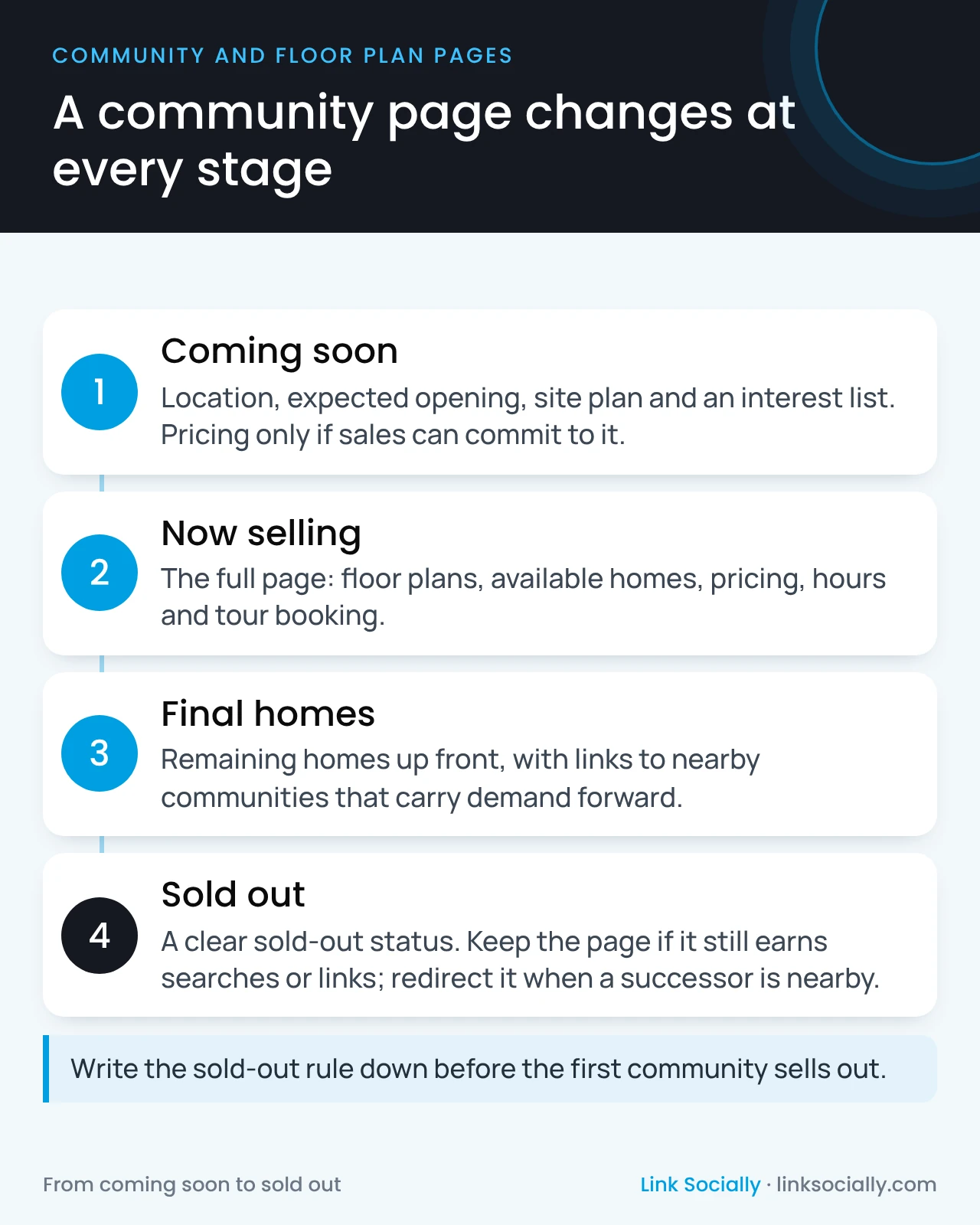
A community page has a lifecycle, and the page should change at every stage. A page that still says “now selling” after the last home closed sends ready buyers to a dead end and tells search engines your site is out of date.
- Coming soon: the location, the expected opening and an interest list, so early demand has somewhere to go.
- Now selling: the full page, with plans, available homes, pricing and tour booking.
- Final homes: the remaining homes up front, with links to nearby communities that will carry demand forward.
- Sold out: a clear sold-out status and a path to nearby active communities, instead of a page that simply disappears.
What happens at sellout is a leadership decision, not a web task. Make it once, in writing, before the next community sells out.
Questions to ask your team or agency
These questions tell you quickly whether community pages are managed as sales assets or left to the template:
- Do we have a written standard for what every community page must show, and how many of our pages meet it today?
- When a price changes or a home sells, how long until the website reflects it?
- Which community pages bring in inquiries and tours, and which get visits but no action?
- What happens to a page when a community sells out, and who decides?
- When a buyer asks an AI assistant about one of our communities, is the answer accurate?
Who owns the community page
Community pages fail more often from ownership gaps than from bad writing. Several teams hold a piece of each page, and the page is only as current as the slowest of them:
- Division sales and marketing own the facts: pricing, available homes, hours and status.
- The content lead owns the words and the community-specific details that make the page unique.
- The web team or vendor owns the template and how quickly changes reach the site.
- The SEO lead or agency owns the page standard and checks pages against it.
Leadership’s part is to approve three things: a written community page standard, a process that updates pricing and inventory on the site when they change, and a quarterly review of every community page against the standard. That standard is the core of a scalable content strategy, and it is what lets the qualified buyer journey work from the first search to the tour.