
Case Study: Aligning Reputation Management with Local SEO for an Enterprise Home Builder

Executive summary: turning reviews into a local SEO asset for a home builder
An enterprise home builder had 90% of its community Google Business Profiles rated below 3.0 stars, and no unified process for answering reviews. We built a reputation management playbook that tied customer care to local SEO strategy, so every review became a chance to protect rankings and win back trust.
The framework replaced passive monitoring with clear ownership, response deadlines, scripted de-escalation, a closed-loop follow-up process, and systematic flagging of reviews that violate Google’s policies. For home builders, where buyers research communities for months before visiting, this turns customer feedback into a local ranking asset instead of a liability.
How low review ratings held back the builder's local search visibility
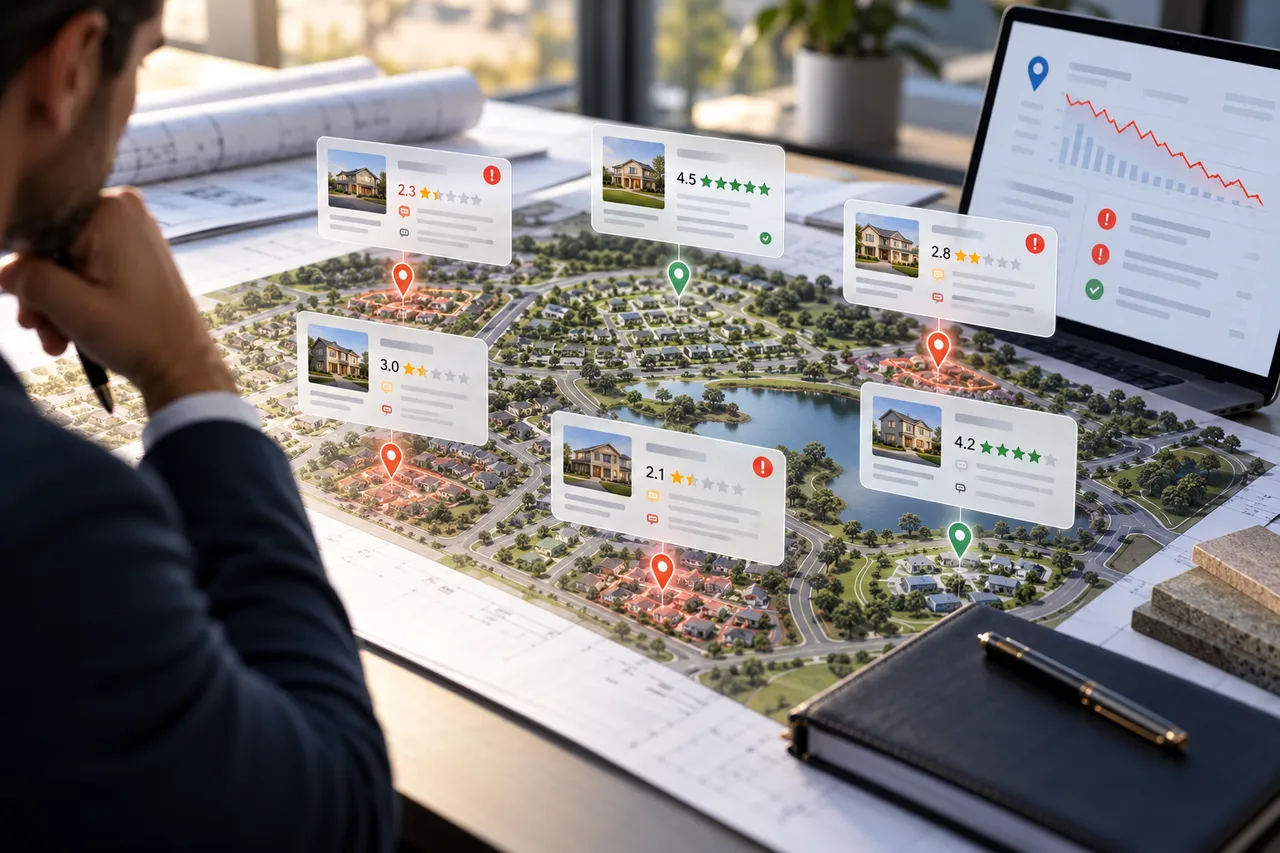
An audit of the builder’s community Google Business Profiles showed a local reputation ecosystem that was holding back search performance.
Profile tier | Share of profiles | Star rating | What was happening |
The 2-star trap | 85% | 2.3–2.9 | Ratings low enough to depress map pack clicks and erode trust during the buyer’s research phase |
Unamplified high performers | 10% | 4.0+ | Strong ratings, but positive reviews often went unanswered, wasting local trust signals |
At-risk tier | 5% | Below 2.3 | Compounding negative narratives, off-topic spam, and unmanaged competitor-driven attacks |
Behind the numbers were operational gaps. Responses varied in tone and rarely sounded like one brand. Complaints were acknowledged but not followed through to resolution. Reviews that broke Google’s policies stayed live because no one was assigned to flag them.
A three-part framework for managing home builder reviews
We deployed a Reputation Management Playbook built on three pillars, with clear ownership and a response deadline for every review.
Tiered response framework. Every review gets a response within 1–3 days. Customer Care owns 1–3 star reviews for fast resolution. The Social team owns 4–5 star reviews to amplify positive experiences.
De-escalation and offline resolution. Scripted response models validate concerns publicly without defensive language. Complex issues, such as construction delays, third-party HOA disputes, or warranty claims, move to private channels where the right team can resolve them. Each review follows the same path:
- Respond publicly with empathy, and invite the customer to connect directly.
- Resolve the issue privately with the responsible team.
- Follow up once it’s resolved, and invite the homeowner to update their review if their experience has changed.
Systematic policy enforcement. A weekly triage process identifies reviews that violate Google’s guidelines and flags them for removal. This covers off-topic spam, harassment, and conflicts of interest, such as reviews promoting a competing builder. Reviews that aren’t removed within 3–5 business days are escalated.
How the playbook changed the response to a negative HOA review
One review captured every risk at once. A homeowner left a long, emotional 1-star review about the community’s HOA, a third-party company, citing inconsistent approvals and months of unanswered requests. They described serious personal hardship that made the experience harder. The review blamed the builder for the HOA’s actions and ended by urging readers to buy from a named competitor.
The response originally posted was two sentences. It said the company was sorry the experience didn’t meet expectations and asked the homeowner to email the customer care team. It didn’t acknowledge the homeowner’s circumstances, the specific complaints, or the builder’s actual role.
The playbook response took a different approach:
Thank you for sharing your feedback. We are deeply sorry to hear about the difficulties you’ve encountered, and we recognize the additional stress you’ve been under. While the HOA is managed by a third-party company and operates independently from us, we understand how important it is that every homeowner feels supported. We take your concerns about communication and transparency seriously. Please reach out to us directly, and we will work with the appropriate teams to make sure your concerns are addressed.
The revised response acknowledges the person first, clarifies responsibility without sounding dismissive, and moves the conversation offline. Future buyers reading the profile notice the response more than the complaint. Because the review promoted a competitor, the playbook also routes it for removal as a conflict of interest.
Expected local SEO outcomes of the review management framework
The framework was designed to move most of the portfolio out of the 2-star trap and back into competitive local visibility. The engagement ended during an organizational restructure, before post-rollout results were measured, so the outcomes below describe what each mechanism was built to achieve.
Reclaiming the 2.3–2.9 range. The follow-up loop has Customer Care return to homeowners after each issue is resolved and invite them to update their review if their experience has changed. Resolved complaints create a path for low ratings to be revised, lifting community averages over time.
Protecting the at-risk tier. Systematic flagging removes invalid negative weight from aggregate scores, including off-topic rants, posts redirecting readers to outside forums, and competitor endorsements. The most damaged 5% of profiles benefit first.
Scaling the top 10%. The Social team publicly engages with positive reviews. This reinforces loyalty and signals active local engagement to search engines, strengthening map pack positioning.
Why review management matters for home builder local SEO
For home builders, every community profile is a storefront that buyers check long before they visit. Reviews shape whether a community appears in the map pack and whether a buyer clicks once it does. Treating reviews as an SEO asset, with clear ownership, consistent responses, and active policy enforcement, protects both visibility and trust across an entire portfolio.
If your communities are stuck below 3.0 stars, or your positive reviews are going unanswered, Link Socially can audit your Google Business Profiles and build a reputation framework your teams can run. Talk to us about your communities.
Frequently Asked Questions
How does online reputation management affect local SEO for home builders?
Online reputation management influences how prospective buyers evaluate home builders in local search results. Google review ratings, review volume, and customer feedback can affect local visibility and buyer trust. For builders managing multiple communities, a consistent review management strategy helps protect brand credibility, improve customer engagement, and support stronger Google Business Profiles across locations.
How can home builders improve low Google Business Profile ratings across multiple communities?
Home builders can improve their review ratings by establishing clear response ownership, addressing customer complaints within defined timelines, and following up after issues are resolved. A centralized reputation management framework also helps teams identify recurring problems, encourage authentic customer feedback, and report reviews that violate Google’s policies. Sustainable improvement depends on resolving customer concerns, not simply responding to negative reviews.
What did Link Socially achieve through this home builder reputation management case study?
Link Socially developed a scalable reputation management playbook after identifying that 90% of the builder’s community Google Business Profiles had ratings below 3.0 stars. The framework established response deadlines, assigned responsibility for positive and negative reviews, introduced customer resolution workflows, and created a process for reporting policy-violating reviews. Although the engagement ended before post-implementation performance could be measured, the strategy established an operational foundation for improving customer trust and supporting local SEO performance.

Who guides the strategy behind Reputation Management & Local SEO?
Cristobal Varela guides this strategy through hands-on experience managing local SEO and online reputation for enterprise home builders. His approach connects Google Business Profile optimization, customer review management, and cross-team accountability to address negative feedback, strengthen community credibility, and protect local search visibility. The focus is on building scalable processes that turn customer feedback into opportunities for stronger buyer trust and long-term local SEO performance.
Next step
Request a Home Builder Reputation & Local SEO Audit
If your home builder communities struggle with low Google ratings, unanswered reviews, or inconsistent customer responses, your local search visibility and buyer trust may be at risk.
Link Socially can help you identify reputation gaps across your Google Business Profiles, evaluate review management processes, and develop a scalable strategy to strengthen community credibility and local SEO performance.