
Buyers ask AI assistants for a shortlist
A buyer who used to open ten tabs can now ask one question: which builders should I look at in this area? The answer usually names a handful of builders, gives a reason for each and, in ChatGPT and several other assistants, links to the sources it drew on.
Being named puts you on that buyer’s shortlist. Not being named means you weren’t considered in that conversation, and nothing in your analytics will tell you it happened. The answers are assembled from what the web says about you: your own pages, your reviews and profiles, local news and the sites that compare builders. Google says the same SEO best practices apply to its own AI features, with no special requirements to appear in them, which is why GEO and SEO are one strategy, not two budgets.
Try it yourself: three questions, five minutes
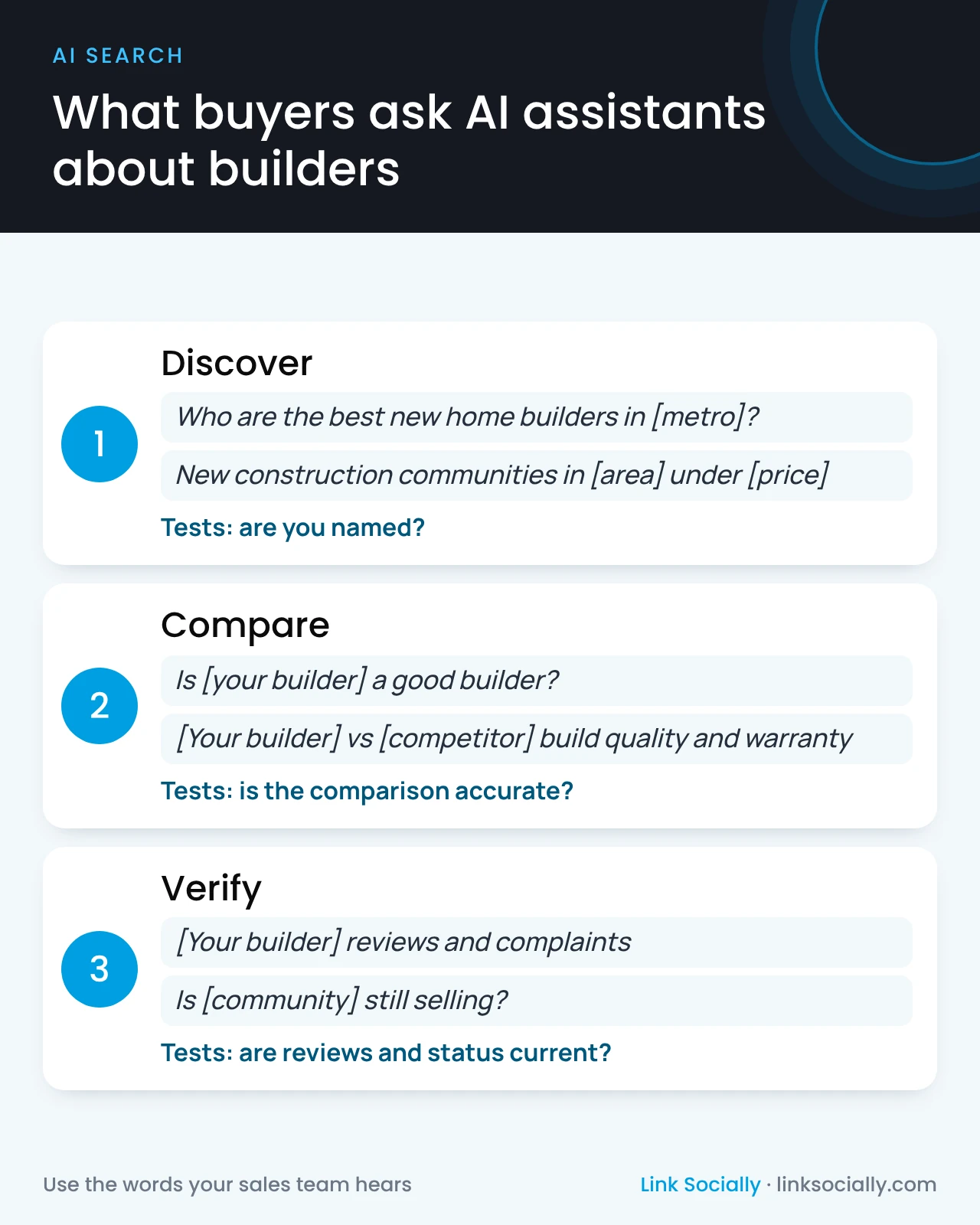
Pick one of your markets and ask an AI assistant the questions a buyer would ask. Buyers move through three stages, and each one tests something different about your reputation.
- Discover. “Who are the best new home builders in [your metro]?” or “New construction communities in [area] under [price].”
- Compare. “Is [your builder] a good builder?” or “[Your builder] vs [competitor] build quality and warranty.”
- Verify. “[Your builder] reviews and complaints” or “Is [community] still selling?”
The questions your sales team hears every week in the sales center are the ones buyers ask AI assistants. Use their words, not marketing language.
Four things to look for in every answer
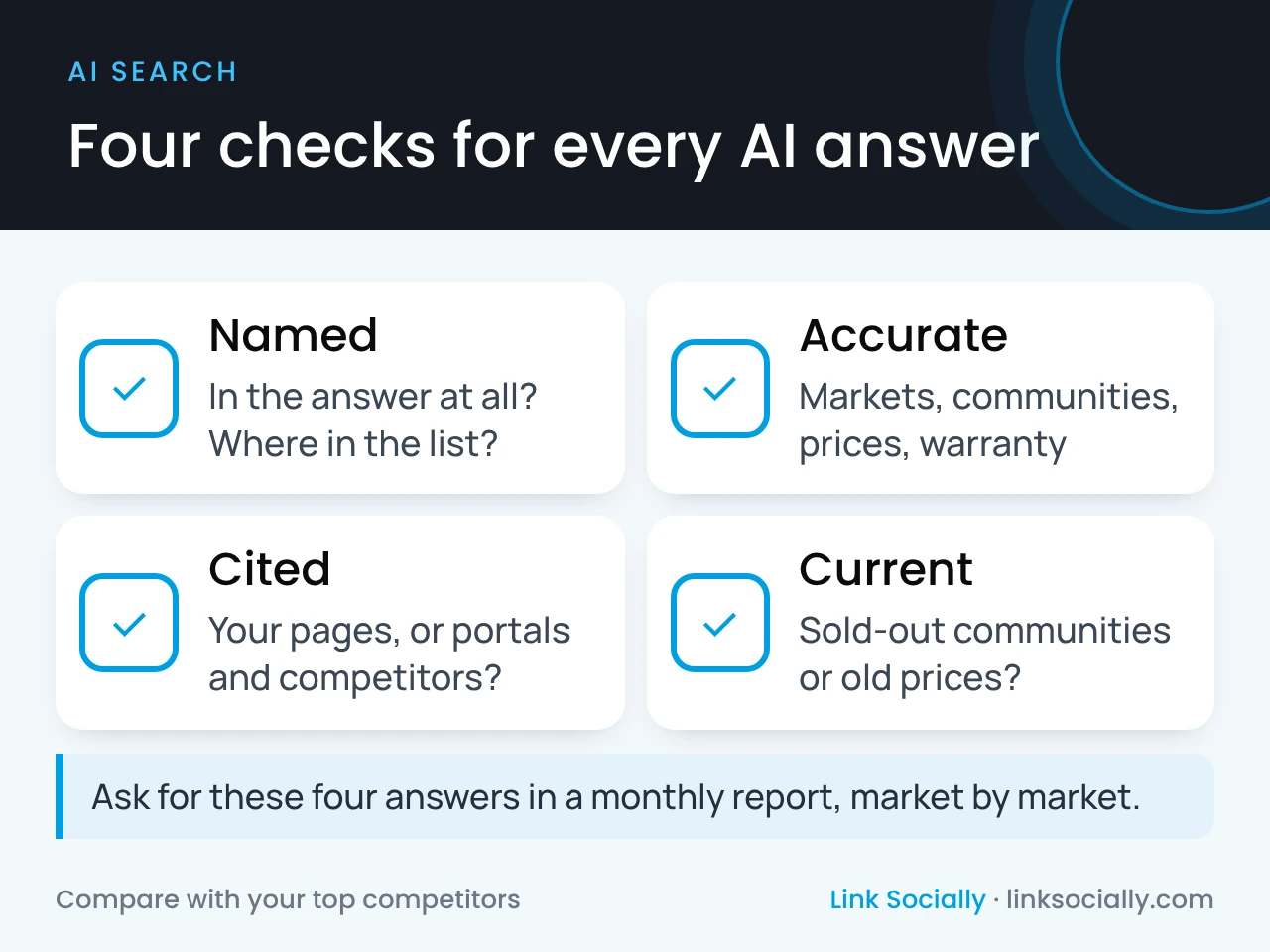
Read each answer the way a buyer would, and look for four things.
- Named. Are you in the answer at all, and where in the list?
- Accurate. Are the facts right: your markets, communities, price ranges, home types and warranty?
- Cited. Does the answer point buyers to your website, or to listing portals, review sites and competitors?
- Current. Does it mention communities that sold out, prices from last year or homes no longer available?
A builder can be named and still lose the buyer. An answer that quotes an old price or sends people to a portal’s page about your community does part of a competitor’s work for them.
What each result tells you, and who fixes it
Each failed check points to a different cause and a different owner. You don’t need to fix them yourself, but you should know which conversation to start.
- Not named. Usually too few trusted sources confirm that you build in that market. Reviews, local press, partner pages and consistent business information are the fix, led by marketing with your agency. This is the work of entity and authority engineering.
- Named but wrong. Your own website doesn’t state the fact clearly, or other sources contradict it. Ask your team to correct the source and follow the approach in defending AI mentions and citations.
- Named but not linked. AI tools may find your pages hard to use, or be blocked from reading them. Ask your web team or agency to confirm that AI search tools can reach the site and that key pages answer buyer questions plainly, as the AI search optimization framework describes.
- Out of date. Sold-out communities still presented as selling, or stale profiles. The fix is a plan for every page as communities change, the same one your community pages need.
Ask for an AI answer report every month
The first time leadership asks these questions, the results are often alarming: a competitor named first, a sold-out community recommended, a price that is a year old. One answer proves little, though. AI answers vary between attempts, between assistants and after the assistants are updated.
So make it a measurement, not a one-time scare. Ask your team or agency for a monthly AI answer report for each market that shows:
- How often you are named, across the same set of buyer questions, in the main AI assistants.
- How often you are named compared with the two or three competitors you lose buyers to.
- Which answers were wrong or out of date, and what is being done about each one.
- The trend over time, next to the search and inquiry numbers you already review.
The guide on measuring AI search performance explains how those numbers are built, if you want to check the method behind the report.
Who should own it
AI answers sit across marketing, sales and the website, so they need a named owner:
- The marketing leader owns the result and reviews it monthly.
- The SEO lead or agency runs the questions, keeps them consistent and turns failures into fixes.
- The sales team adds the questions buyers ask in sales centers and on calls.
What this buys you is a view of part of the buyer’s research that analytics can’t show, and a way to correct the answers that send buyers elsewhere. It is the routine at the center of our AI search visibility work.