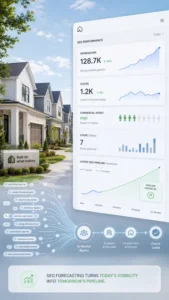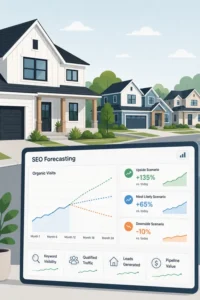

A controlled PPC pause revealed that the SEO forecast was not wrong. The reporting model was.
| Measurement Layer | Dashboard Reading | Corrected Interpretation |
| Reported organic traffic | -13% year over year | The report made SEO look weaker than it was. |
| Isolated organic baseline | +65% traffic increase | Organic assets were generating meaningful growth. |
| Primary distortion | Paid search credit capture | PPC intercepted demand that SEO had already earned. |
| Leadership risk | Budget confidence dropped | The issue was attribution integrity, not failed organic growth. |

A national home builder had invested in a comprehensive organic search initiative. The work included resolving an 83% keyword cannibalization overlap, strengthening structured data, improving local SEO hub assets, and clarifying how high-intent pages supported buyer discovery.
Based on those improvements, the forecast expected organic visibility and qualified traffic to increase. The model was not built around vague keyword optimism. It was tied to corrected architecture, cleaner page intent, and improved search engine crawl signals.
Then the third-quarter dashboard created a serious leadership problem: instead of showing growth, organic traffic appeared to be down 13% year over year.
For the executive team, this created a direct budget question: was SEO underperforming, or was the measurement layer failing to show what was really happening?
The home builder was running paid search campaigns at the same time organic visibility was improving. In competitive residential markets, that is common. Paid campaigns can support promotions, protect brand visibility, and create fast visibility during community launches.
The problem appears when paid campaigns and organic pages target the same high-intent terms without a clean attribution framework. In this case, paid ads were appearing for searches where the brand already had strong organic visibility. As a result, PPC received conversion and traffic credit for demand that organic search had helped create or was already positioned to capture.
The forecast was evaluating the organic asset. The dashboard was blending the channel environment.
To isolate the source of the variance, the team initiated a controlled Dark Week. During this period, paid search campaigns were temporarily paused so organic search behavior could be evaluated without paid search intercepting the same demand.
This was not a recommendation to abandon paid media. It was a measurement control. The objective was to determine whether SEO had failed to generate demand or whether attribution overlap had been masking the value of organic visibility.
| Before the Dark Week | After the Dark Week |
| SEO appeared to be declining. | SEO showed clear growth from the isolated baseline. |
| Paid search looked more valuable than it actually was for overlapping terms. | Paid value could be separated from organic equity. |
| Leadership risked cutting or questioning the wrong channel. | Leadership could evaluate SEO and PPC with more discipline. |
| Forecast confidence was challenged by noisy reporting. | Forecast confidence improved after attribution cleanup. |
Home builder websites are structurally more difficult to measure than simple lead generation sites. A single domain may include state pages, city pages, community pages, floor plans, quick move-in homes, inventory pages, blog assets, sales center pages, and branded community searches.
When that architecture is combined with paid search, local packs, branded demand, and long sales cycles, basic reporting can easily misrepresent what is actually driving qualified buyer interest.
| Risk | How It Distorts the Forecast |
| Paid search overlap | Paid campaigns can capture clicks and leads that organic rankings were already positioned to receive. |
| Branded demand inflation | Traffic from people already searching the builder or community name can make SEO look stronger than net-new discovery actually is. |
| Internal page cannibalization | City, community, inventory, and blog pages may compete for similar regional intent, weakening ranking clarity. |
| Delayed implementation signals | Forecast timelines shift when technical changes, content updates, or CRM fixes are delayed. |
The forecast assumed that organic improvements would increase visibility and traffic once search engines processed the updated architecture. That assumption was supported by the corrected organic baseline.
The issue was not the concept of forecasting. The issue was that the reporting layer failed to separate organic demand from paid search interception. When paid and organic search were analyzed as overlapping systems rather than independent channels, the apparent performance story changed.
This distinction matters for leadership. A weak forecast can mislead budget decisions. But a good forecast can still be undermined if the measurement layer is polluted by attribution overlap, branded search inflation, or unclear page ownership.
After the Dark Week revealed the true baseline, the recommended next step was not to frame SEO and PPC as opposing channels. The next step was to give each channel a cleaner job.
For home builders, the cost of a bad measurement model is not limited to an inaccurate report. It can affect media budgets, sales expectations, market expansion timing, content planning, staffing, and leadership confidence in organic growth.
A dashboard that shows SEO declining may push leadership to increase paid spend, cut content investment, delay technical fixes, or misjudge the value of local organic assets. In this case, the opposite was true: organic visibility was growing, but paid search attribution made that growth harder to see.
The lesson is simple: before deciding whether SEO is working, home builders need to know whether their reporting environment is clean enough to answer the question.
A home builder SEO forecast should not be accepted or rejected based on a single traffic graph. Leadership should require a validation process that separates demand sources, isolates risk, and explains the assumptions behind projected growth.
| Validation Step | Executive Question It Answers |
| 1. Validate tracking and CRM data | Are forms, calls, lead sources, and sales actions being measured consistently? |
| 2. Separate branded and non-branded demand | Are we capturing new buyers or mostly existing brand awareness? |
| 3. Audit paid and organic overlap | Are we paying for clicks that organic search could already capture? |
| 4. Review page-level intent conflicts | Are city, community, inventory, and blog pages competing against each other? |
| 5. Model multiple scenarios | What is the conservative, expected, and aggressive growth range under current conditions? |
Link Socially uses attribution audits, page intent analysis, branded vs non-branded segmentation, and paid search overlap reviews to make home builder SEO forecasts more reliable. The goal is not to promise an exact traffic number. The goal is to reduce uncertainty and help leadership understand what the organic channel is truly contributing.
This case study shows why forecasting cannot be separated from measurement integrity. When the data is clean, leadership can make better decisions about SEO investment, paid search allocation, market expansion, and long-term organic growth planning.
For the commercial service page, review SEO forecasting for home builders. For the broader enterprise measurement framework, explore SEO reporting and forecasting services.
If your organic reporting is unclear, your paid media strategy may be distorting the true value of SEO. Link Socially can help isolate the data, evaluate channel overlap, and build a cleaner forecasting model for qualified home buyer demand.
The dashboard showed a decline because paid search was intercepting traffic from overlapping high-intent queries. When paid campaigns were paused during the Dark Week, the isolated organic baseline revealed that organic traffic had actually increased.
A Dark Week is a controlled measurement period where paid campaigns are temporarily paused or isolated so the team can evaluate how much demand organic search can capture without paid media overlap.
No. Paid search can still be valuable for competitive markets, urgent promotions, and new community visibility. The issue is not paid media itself; the issue is running paid and organic strategies without clear attribution separation.
Branded search reflects people already looking for the builder, community, or model name. Non-branded search reflects new buyer discovery. A reliable forecast must separate both so leadership can understand true market expansion.
A home builder should validate tracking, CRM data, branded and non-branded search demand, paid and organic overlap, page-level cannibalization, local market differences, implementation timing, and scenario assumptions.
To learn how to isolate your true organic search equity and eliminate multi-channel reporting noise, discover how our team delivers absolute visibility through specialized Link Socially SEO Reporting & Forecasting services.

Related Posts