

When a corporate website experiences a surge in organic impressions without a proportional increase in sales leads, executive teams frequently misinterpret the data as a marketing failure. In reality, this data represents latent search equity—an algorithmic testing phase where search engines evaluate a domain’s topical authority before granting page-one positioning.
This guide provides the strategic solution. By running these early-stage signals through an objective SEO forecast, CEOs, CMOs, and business owners can more accurately project future click capture, align search intent with the sales funnel, and make data-backed budget decisions before waiting months for final conversions to mature.
For companies that need a broader forecasting framework, this process should connect naturally with a dedicated SEO Reporting & Forecasting strategy and a long-term Organic Growth Engine that turns early visibility into measurable pipeline growth.
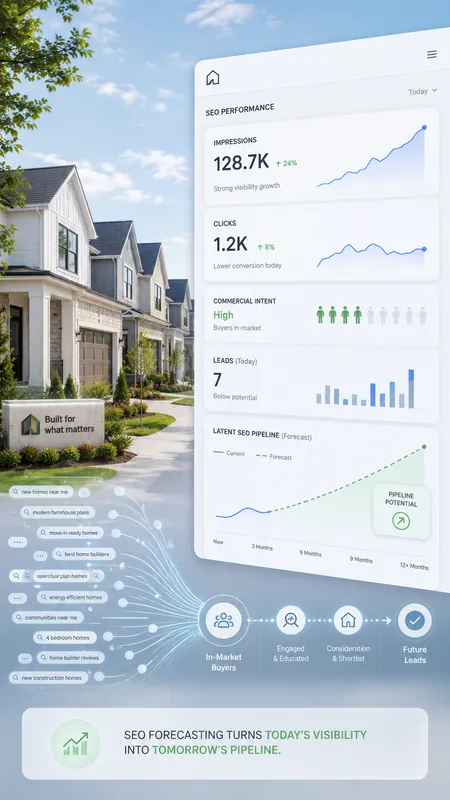
For business leaders, a marketing dashboard showing thousands of search impressions alongside near-zero lead growth can look like an operational contradiction. To make accurate business decisions, the C-suite must understand how search engine algorithms allocate digital visibility.
Before a search engine shifts a website into the top three organic positions—where a large share of user clicks usually occurs—it tests the website’s contextual relevance behind the scenes. The algorithm accomplishes this by displaying your URLs on deep results pages or within temporary testing blocks for high-volume search terms.
Every time your site is displayed in these deep testing environments, an impression is recorded, but a user click is rare. This operational lag is a natural phase of organic market capture; the search engine is verifying your domain’s authority before routing active buyers to your assets.
This is also why executives should avoid evaluating SEO only through short-term lead volume. A stronger approach is to connect Search Console signals with SEO Strategy Roadmapping, so early visibility patterns can inform page prioritization, internal linking, and content investment.
To turn raw data into an actionable business planning asset, leadership teams must look past the aggregate metrics on an organic dashboard. You must demand that your marketing division isolate the specific non-branded search terms that are driving your impression velocity.
By isolating search queries that have high impression volume but low click yield, companies can map out exactly where the market is trying to engage with their brand. This data filtration allows executives to identify emerging market demand before competitors capture it.
Understanding how to handle these early visibility signals is a core component of a modern SEO forecasting framework and gives leadership teams a clearer path to evaluate organic growth opportunities before they fully mature.
To clean up reporting data and find these hidden growth opportunities, enterprise teams should filter their search datasets using the following strict structural parameters:
| Filtering Parameter | Search Console Setting | Strategic Business Purpose |
|---|---|---|
| Position Threshold | Average Position greater than 10, or Page 2+ | Isolates keywords currently in the algorithmic testing phase |
| Impression Volume | Sorted by descending volume | Identifies maximum latent market demand and buyer interest |
| Click Threshold | Clicks matching near-zero | Eliminates current conversion noise to find hidden opportunities |
For deeper analysis, these high-impression terms should be cross-checked against Keyword & Market Intelligence data to determine whether they represent broad awareness, commercial demand, or immediate revenue opportunities.
Not all search impressions possess equal financial value. A sudden spike in organic visibility must be structurally audited to determine where the traffic is entering your marketing funnel.
When a website earns thousands of impressions on high-volume informational keywords, such as users seeking general definitions or free resources, the financial conversion rate will usually be lower. Conversely, when impression velocity occurs around specific commercial or transactional keywords, it signals a more profitable pipeline opportunity.
Executive teams must ensure their marketing divisions assign different mathematical weights to these traffic pools within their forward-looking models. Treating all search volume identically leads to inaccurate sales projections and misallocated capital spend.
An influx of impressions on commercial keywords indicates that the search engine may be preparing to rank your service or product pages for high-intent buyers. Even if these keywords have lower total search volumes than broad informational topics, their downstream impact on your customer acquisition cost, CAC, and net revenue pipeline is significantly higher. That makes them primary targets for aggressive budget support.
This is where Revenue-Driven SEO becomes essential. The objective is not only to increase visibility, but to prioritize the queries and pages most likely to influence qualified leads, pipeline value, and customer acquisition efficiency.
The primary business benefit of tracking early-stage search data is the ability to run a predictive click yield calculation. This equation allows the C-suite to treat current impression metrics as a forward-looking revenue pipeline.
Instead of guessing when an investment will pay off, financial and marketing executives can apply historical first-page click-through rates, CTR, to their existing page-two impression volumes. This calculates the estimated volume of inbound web traffic the company may capture once those tested URLs migrate into stable page-one positioning.
The mathematical model used to project future click acquisition from latent search metrics follows this logic:
Projected Future Clicks = Current Impression Volume × Expected First-Page CTR
By multiplying this projected click volume by your verified website-to-lead conversion rate, the CFO can establish a data-backed baseline for future lead generation, turning invisible search engine validation into a tangible corporate asset.
If the forecast shows strong click potential but weak conversion readiness, the next step should include landing page improvements, stronger calls to action, and service-page optimization supported by Scalable Content Strategy.
Once your growth team has isolated your latent search queries and calculated their click yield potential, these metrics must be integrated into your company’s long-term corporate forecasting models.
A sudden surge in impressions proves that the algorithmic door is open for your brand. If a key service page or product line shows high impression velocity, it serves as a leading indicator that additional content optimization and internal linking enhancements may yield meaningful traffic results.
To build maximum predictive accuracy, these early-stage signals should eventually be paired with advanced statistical modeling, including data science, historical query behavior, seasonality, conversion trends, and time-series analysis for SEO forecasts.
This process also helps determine whether your website needs a deeper SEO Audit for Scale before increasing content spend. If technical blockers, weak internal links, or unclear page roles are limiting click capture, forecasting should lead to prioritization, not just reporting.
A website can generate high Google impressions before it earns strong clicks or leads because search engines may be testing its relevance on deeper results pages or for broader search terms. This does not always mean the SEO campaign is failing. It may indicate that your site is building early visibility but still needs better rankings, stronger click-through optimization, and clearer conversion paths.
Yes. High-impression, low-click keywords can reveal latent search demand. When these keywords are filtered by position, intent, and commercial relevance, they help leadership teams identify future growth opportunities before they become obvious in lead reports. They are especially useful for forecasting future clicks, content priorities, and pipeline potential.
SEO forecasting helps translate early search visibility into business planning. By estimating future clicks from high-impression queries and applying verified conversion rates, companies can project potential lead volume. This allows executives to prioritize technical SEO, content optimization, internal linking, and conversion improvements based on expected business impact.
A website that generates thousands of Google impressions without an immediate flow of inbound leads is not a broken marketing asset; it is an unmined digital revenue pipeline. For CEOs, CMOs, and business owners, these metrics represent the early warning system of future organic market share.
Rather than ignoring these invisible signals or abandoning campaigns prematurely, sophisticated leadership teams use this data to build a forward-looking SEO forecast that brings clearer visibility to future sales pipelines.
By systematically auditing impression velocity, separating broad browsing behavior from commercial intent, and calculating estimated click yield potential, companies can transform abstract search data into clear corporate growth decisions.
To learn how to isolate your latent search equity and translate complex Search Console data into executive-level clarity, explore Link Socially’s specialized SEO Reporting & Forecasting services.

Related Posts