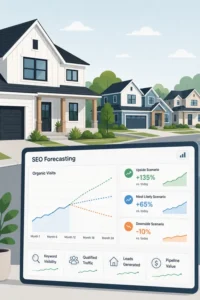

Most growth executives have a dashboard that says everything is fine: rankings holding steady, organic sessions flat but not falling, impressions consistent quarter over quarter. And most growth executives have also started noticing something that dashboard can’t explain — inbound demo requests slowing down, discovery calls getting harder to book, deals that used to originate from organic search simply not showing up anymore.
These two facts aren’t a contradiction. They’re a pattern — and it’s becoming one of the most common blind spots in enterprise marketing reporting right now. The reason your SEO metrics can look completely healthy while your pipeline quietly dries up has nothing to do with your rankings slipping. It has to do with where the buying journey is actually ending before it ever reaches your website.
The Disconnect Between Search Metrics and Sales Pipeline
For a decade, the formula was simple: rank well, earn clicks, convert traffic into pipeline. That relationship is breaking — not because rankings stopped mattering, but because generative AI tools are increasingly resolving the buyer’s question before a click ever happens.
When a decision-maker asks ChatGPT, Claude, Gemini, or Perplexity to compare vendors or recommend a solution, the AI can summarize the landscape, name specific companies, and answer the question directly on that screen. No click, no session, no attributable traffic — and no visibility into what just happened inside your analytics. Your dashboard has no way to show you a buyer journey that never touched your website at all.
That’s why the metrics you’re used to trusting — rankings, impressions, sessions — can stay flat while the thing they were always a proxy for, pipeline, quietly declines. The dashboard isn’t wrong. It’s just no longer measuring the whole picture.
Most enterprises don’t notice this shift until it shows up in a board meeting as an unexplained pipeline gap. These four patterns tend to appear first:
Long-form articles that traditional crawlers index just fine can still be filtered out of the sources AI models actually draw on, because they lack the clean entity and semantic structure generative systems require.
When a buyer asks an AI tool to compare top solutions in your category, being left out of that answer means you’re eliminated before your sales team even has a chance to make contact.
If your site’s structured data and schema haven’t kept pace, you lose the direct signal AI systems rely on to verify and reference you as a trustworthy source.
While your team continues optimizing for legacy metrics, competitors investing in entity structure and third-party validation are building a lead in AI visibility that gets harder to close the longer it goes unaddressed.
None of these show up on a standard SEO dashboard. All four show up in your pipeline.
Most executive dashboards were never built to answer the question that matters most today: is our brand actually showing up when AI tools answer buyer questions? Rank trackers and traffic reports simply weren’t designed for it. That gap is exactly why so many leadership teams feel confident in their SEO reporting while a real pipeline problem goes undetected underneath it.
At Link Socially, we treat AI visibility as its own measurement discipline, built around signals most reporting tools don’t surface yet:
how often your brand is named in AI-generated answers for your category, relative to competitors. This is the modern equivalent of SERP share: are you in the room when the shortlist gets made?
whether AI tools describe your brand correctly, not just whether they mention it. A wrong or outdated description can cost a deal as surely as no mention at all.
a drop in direct brand searches, even while rankings stay flat, often signals buyers are getting resolved answers inside AI tools before ever searching for you by name.
how uniformly your brand is described across your own site, third-party sources, and structured data. This is the leading indicator behind all the others; inconsistency here predicts weak citation performance before it shows up anywhere else.
None of these appear on a standard analytics dashboard today — which is precisely why most enterprise leadership teams aren’t tracking them yet, and why the ones who start now build a lead that compounds. This is the exact measurement lens Link Socially applies inside every AI Visibility Risk Assessment, so leadership walks away with more than a diagnosis — a clear read on where the brand actually stands, by the metrics that will matter most going forward.
The instinct, once this gap is identified, is often to assume the fix requires an entirely new budget line — a separate “AI strategy” on top of existing SEO spend. It doesn’t. Most of what needs to change is where your existing investment goes, not how much of it there is.
Two shifts matter most:
(We go deeper on why your existing SEO foundation is the asset this all builds on — not something to abandon — in [Future-Proofing Your Organic Growth Strategy for the Generative AI Era].)
The following is based on an anonymized client engagement; details have been generalized to protect confidentiality.
A regulated healthcare platform came in with a familiar pattern: solid technical SEO, reasonable rankings, but almost no presence in AI-generated answers when tested against real buyer questions in their category. The focus wasn’t more content volume or a separate “AI budget” — it was entity optimization, medical schema, structured content, and clearer topical coverage.
Within the engagement, AI-driven search visibility moved from 17% to 78% — without abandoning the existing technical SEO foundation, and without a parallel spend increase. The fix was structural: closing the entity and schema gaps that were quietly keeping AI systems from confidently retrieving, verifying, and citing the brand.
This is the same pattern this article opened with — flat-looking metrics masking a real visibility gap — and the same fix: reallocating existing investment toward entity clarity and structured data, not adding a new budget line.
Compare your branded and direct search query volume against your organic rankings over the same period. If rankings and impressions are flat but branded search and inbound demo requests are declining, that divergence is the clearest early signal that buyers are resolving their questions inside AI answers before reaching your site.
Not always — seasonality, market shifts, and campaign changes can all cause similar dips. But when it happens alongside otherwise-stable organic metrics and no clear external cause, AI interception is one of the most common explanations worth ruling in or out first.
No — this isn’t a separate initiative to fund, it’s a reallocation of the same budget toward entity clarity and technical structure instead of content volume. (See [Future-Proofing Your Organic Growth Strategy for the Generative AI Era] for the full reasoning on why your SEO foundation carries directly into AI visibility.)
Watch citation frequency and accuracy in AI-generated answers as a leading indicator — it typically moves before pipeline does, since it reflects whether AI systems are starting to trust and surface your brand, ahead of that translating into inbound demand.
This framework is built by Cristobal Varela, Senior SEO Manager and organic growth strategist with 20+ years diagnosing exactly this kind of disconnect — where standard reporting looks healthy while pipeline quietly erodes. Across enterprise, healthcare, and regulated environments, Cristobal has used deep analytics work (Google Search Console, GA4, Looker Studio, SEMrush) to trace pipeline drops back to their real cause, including AI-driven visibility gaps invisible to conventional dashboards.
Cristobal is the author of What Executives Get Wrong About SEO and has completed advanced training in agentic AI systems through Harvard’s Data Science Initiative, alongside an ongoing postgraduate program in AI Agents for Business Applications at Texas McCombs — credentials that keep this diagnostic approach current with how AI systems actually retrieve and evaluate brands today, not just how search engines used to.
Stable rankings and flat traffic used to mean things were fine. Under generative AI, they can just as easily mean your buyers are getting their answers somewhere your dashboard can’t see. The fix isn’t more content or a bigger budget — it’s redirecting what you’re already spending toward the entity clarity and technical structure AI systems actually rely on.
Link Socially can help you find out which one it is before it shows up as a board-level pipeline problem:

Related Posts