
When a buyer asks an AI assistant to recommend a vendor, compare solutions, or solve a specific problem, the answer is often decided before your website is ever visited — and before your sales team knows a deal exists. Standard search rankings don’t govern that answer. A separate set of signals does, and most enterprise brands have never been evaluated against them.
This page outlines the framework Link Socially uses to get enterprise brands found, described accurately, and recommended inside AI-generated answers — and what’s actually required to compete for that placement, rather than lose it by default.
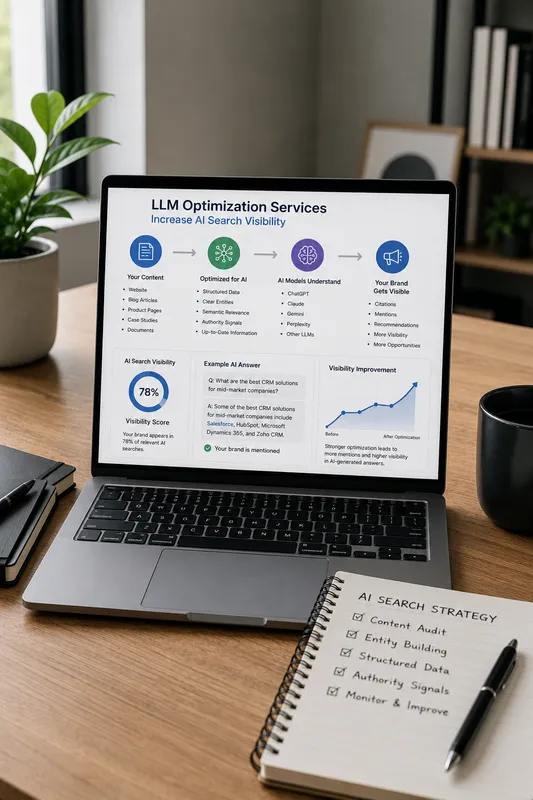
High-intent buyers across B2B, SaaS, and considered-purchase markets are increasingly letting AI assistants do the shortlisting for them — filtering, comparing, and recommending vendors before a single traditional search result is ever clicked. Your organic dashboards can look completely healthy while this happens, because the tools you’re used to trusting were never built to see it. (We break down exactly how to spot this gap in your own funnel in [The Silent Pipeline Leak Hiding Behind Stable SEO Metrics].)
This isn’t a tactic to bolt onto your existing marketing plan. It’s a shift in where market share is actually won — from websites that depend on clicks, to brands an AI system trusts enough to name outright.
Traditional SEO was built for an index-and-rank world: a crawler reads a page, matches it to a query, and returns a list of links. Generative AI systems work differently — they pull from thousands of cross-web reference points to construct a single answer, and they favor brands whose identity, claims, and credibility can be clearly verified across that web, not just on one domain.
That means publishing more content doesn’t move the needle the way it used to, and a strong technical SEO foundation — while still essential — isn’t sufficient on its own either. (We go deeper on why your SEO foundation is the starting point, not the finish line, in [Future-Proofing Your Organic Growth Strategy for the Generative AI Era].) What actually influences an AI system’s recommendation is entity clarity, structured data, and verified third-party validation working together — which is the core of the methodology below.
The following results are drawn from anonymized client engagements.
These aren’t projections. They’re what happens when entity clarity, technical structure, and validation are treated as the foundation of a growth strategy, not an afterthought to it.
A strong SERP position doesn’t mean a competitor has actually done this work. In direct competitive audits, the most common gaps we find are strikingly consistent:
None of these gaps require a bigger budget to fix. They require someone who knows exactly what to look for — which is the audit every engagement with us starts with.
The following results are drawn from anonymized client engagements.
These aren’t projections. They’re what happens when entity clarity, technical structure, and validation are treated as the foundation of a growth strategy, not an afterthought to it.
We deploy an integrated framework built to move your brand from basic indexing to active recommendation across AI systems:
This isn’t three disconnected services. It’s one system: your existing SEO foundation, made legible and verifiable to the models now making the recommendation on your buyer’s behalf.
You likely need a dedicated AI visibility framework if:
This framework is built and led by Cristobal Varela, Strategic Partner at Link Socially and author of What Executives Get Wrong About SEO. Over more than 20 years leading technical SEO and organic growth strategy for enterprise, healthcare, and regulated organizations, Cristobal has produced measurable, verifiable outcomes — including AI visibility gains of up to 3,989% year-over-year — by treating entity clarity, structured data, and technical foundation as one integrated system rather than separate initiatives.
Cristobal holds a certificate in Agentic AI from Harvard’s Data Science Initiative and a postgraduate program in AI Agents for Business Applications at Texas McCombs School of Business — ensuring this methodology reflects how AI systems actually operate today, not how search worked a decade ago. Every engagement is led personally by Cristobal and executed by the same team responsible for the results above.
Traditional SEO tracks keyword rankings for specific URLs. AI visibility tracks whether, how often, and how accurately an AI system cites your brand by name across the actual questions your buyers ask — a different signal that a rankings report can’t show you.
Alongside. This framework builds on your existing technical SEO and content investment rather than replacing it — the goal is making that investment legible to AI systems, not starting over.
A clear picture of where your brand currently stands in AI-generated answers for your category, what’s causing any gaps — entity inconsistency, missing validation, technical structure — and a prioritized plan for closing them.
Yes. Inconsistent product descriptions, regional messaging, or conflicting brand data across domains fractures how clearly an AI system can verify who you are. Aligning that footprint into one coherent, verifiable entity is a core part of this methodology.
Every quarter your brand is absent from AI-generated recommendations is a quarter competitors are being named in your place — often without a materially better product, just a clearer, more verifiable digital footprint.
Link Socially can show you exactly where you stand and what it will take to change that:
Related Posts