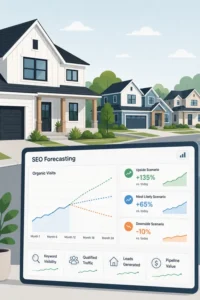

AI search does not make organic visibility less important. It makes organic visibility harder to measure with old dashboards.
When AI Overviews, generative answer engines, and LLM retrieval systems answer questions directly inside the search experience, a brand can become more visible while traditional click metrics look smaller. That shift can confuse leadership if reporting still treats organic performance as a simple ranking-to-click equation.
This guide explains how executive SEO measurement should adapt for AI-driven discovery by tracking citation share, zero-click deflection, conversational query velocity, and entity visibility instead of relying only on legacy rankings and standard CTR curves.

The strategic goal of SEO has not changed: the business still needs qualified visibility, trust, demand capture, and measurable pipeline. What has changed is the path between visibility and the click.
In traditional search, leadership could often connect ranking improvements to click growth. In AI-shaped search, the same page may support a generated answer, earn a citation, influence brand selection, or assist a high-intent click without producing the same broad traffic curve as before.
That means executives need a measurement framework that explains both direct clicks and assisted discovery. AI search performance measurement fills that gap.
For years, SEO reporting treated keyword ranking position as the main proxy for organic market share. In generative search, position still matters, but it is no longer the only visibility layer leadership should evaluate.
Citation Share measures how often AI systems reference, cite, summarize, or rely on a brand, URL, author, data point, case study, service page, or knowledge asset when forming an answer. A page that earns repeated citation in AI results may influence buyer perception even when the user does not immediately click.
Entity visibility is the supporting layer. It evaluates whether the brand, services, locations, authors, proof assets, and structured data are consistent enough for AI systems to understand and recommend them.
| Legacy SEO metric | AI-search measurement signal | Executive implication |
| Keyword ranking | Citation Share | Shows whether AI systems select the brand, URLs, or data assets as trusted sources in generated answers. |
| Organic CTR | Zero-click Deflection | Explains why visibility can increase while website clicks compress because answers are delivered inside the search interface. |
| Exact-match search volume | Conversational Query Velocity | Captures emerging demand across long, scenario-based searches that traditional keyword tools may undercount. |
| Traffic by URL | Entity Visibility | Measures whether the brand, services, locations, authors, and proof assets are consistently understood across retrieval layers. |
| Monthly dashboard review | AI Search Signal Review | Gives leadership a clearer view of discovery, citation, click compression, and qualified downstream demand. |
Citation Share is useful because it shifts the conversation from raw ranking position to source selection. The question becomes: when an AI system explains this topic, which companies, URLs, and proof assets does it trust enough to use?
For executive reporting, this can be segmented by topic, service line, market, funnel stage, and query type. A company may have strong citation visibility for educational questions but weak visibility for commercial comparisons. It may be cited for broad definitions but absent when buyers ask who can solve the problem.
This distinction matters because AI search can filter users before they reach the website. The users who do click after seeing a trusted source citation may arrive with stronger intent than users from broad informational searches.
Zero-click deflection describes the gap between being visible in the search experience and receiving a website visit. In AI-shaped results, a user may get enough information from the generated answer to delay, reduce, or skip a click.
Legacy reporting may interpret that reduced click volume as weaker SEO performance. In reality, the brand may still be shaping discovery, comparison, and trust inside the search interface.
This does not mean clicks no longer matter. It means click data needs context. A smaller clickstream may be more qualified if AI results absorb broad research behavior and leave the website with users who are closer to evaluation or purchase.
AI search also changes how people ask questions. Instead of short keyword fragments, users increasingly search with longer, scenario-based prompts that describe their business context, constraints, location, and decision criteria.
Traditional keyword tools may show little or no exact-match volume for those queries. That does not mean the demand is absent. It means the demand is fragmented across many semantically related questions.
Conversational Query Velocity tracks how quickly these long-form question clusters appear, expand, and shift. This helps teams identify buyer language earlier than exact-match keyword volume alone would allow.
A stronger measurement model should combine legacy SEO signals with AI-specific visibility signals. Rankings, traffic, and conversions still matter, but they need to be interpreted alongside answer inclusion, citation behavior, entity consistency, and zero-click compression.
| Signal | What it measures | What to monitor |
| Citation Share | How often the brand or URL is cited, referenced, or used as a source in AI-generated answers. | Source trust, entity authority, answer inclusion, comparison visibility. |
| Zero-click Deflection | How often the search interface satisfies intent before the user clicks through to the website. | AI Overview presence, answer completeness, CTR compression, query class risk. |
| Conversational Query Velocity | How rapidly long-form, scenario-based questions appear around a topic, location, problem, or buying situation. | Question clusters, semantic variants, prompt-like searches, emerging buyer language. |
| Entity Consistency | Whether AI and search systems see the same facts across pages, schema, profiles, and supporting content. | Organization data, service descriptions, locations, authorship, case studies, structured data. |
| Qualified Click Residue | The smaller but higher-intent clickstream that remains after AI answers filter broad research behavior. | Lead quality, conversion rate, assisted conversions, sales-qualified interactions. |
AI-search measurement should feed a forecast, but this article should not become the primary page for SEO forecasting services. Its job is to define the AI visibility signals that a modern forecast must consider.
The deeper commercial framework belongs on Link Socially’s SEO Reporting & Forecasting services page. That page should own the service, dashboards, scenario modeling, KPI governance, and executive consultation intent.
This article should support that page by explaining why AI search changes the input signals. Forecasts that ignore AI Overviews, citation share, zero-click behavior, and conversational queries may overstate clicks or understate brand influence.
Before leadership accepts an AI-search performance report, the team should clarify what is being measured, what is being inferred, and what still requires validation through downstream business data.
AI search visibility depends on clarity, consistency, and proof. Search and answer systems need to understand what the company does, who it serves, where it operates, what evidence supports its claims, and which pages answer specific questions.
AI search performance measurement is the process of evaluating how a brand appears in AI Overviews, generative answer engines, LLM retrieval systems, and traditional search results using signals such as citation share, zero-click behavior, entity visibility, and qualified downstream clicks.
Citation Share measures how often AI systems reference, cite, or rely on a brand, URL, author, data asset, or page when generating answers for relevant search queries or conversational prompts.
SEO clicks can decline while AI visibility increases because AI summaries and answer engines may satisfy part of the user intent directly on the results page. This can compress broad clicks while still influencing brand discovery and qualified decisions.
Zero-click deflection is the difference between search visibility and website visits when the search interface answers enough of the query that the user does not need to click immediately.
AI-search signals should inform forecasting by adjusting assumptions around click-through rates, conversational demand, citation visibility, and assisted discovery. The commercial forecasting model should live on the service pillar, while this article explains the AI measurement inputs.
AI search does not remove the need for SEO. It removes the usefulness of shallow measurement.
If leadership only looks at rankings and clicks, AI-driven discovery may appear weaker than it actually is. If the team also tracks citation share, zero-click deflection, conversational query velocity, and entity visibility, the company can understand how search visibility is changing before budget decisions become reactive.
The next step is to connect these AI-search signals to business-level reporting. Explore Link Socially’s SEO Reporting & Forecasting services to see how executive measurement, predictive reporting, and AI-aware SEO analytics can support clearer planning decisions.

Related Posts