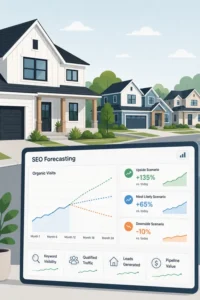

This guide establishes a strategic framework for corporate leadership teams to accurately forecast SEO growth before expanding marketing budgets. By transitioning from retroactive business reporting to forward-looking SEO forecasting, CEOs, CMOs, and CFOs can differentiate between superficial vanity metrics and legitimate organic search pipeline. The following analysis details how to audit search layout volatility, separate branded demand from non-branded market opportunities, isolate paid media attribution overlap, and translate raw search impressions into predictable corporate revenue streams to support data-backed business decisions.

For years, the standard measure of organic performance has been first-page keyword positions. While tracking where your website ranks is highly relevant for technical execution, top rankings alone do not prove a return on investment for business leaders.
A business does not grow because it ranks position one for a specific phrase; it grows because that position captures qualified buyer intent. If your organic visibility increases across informational search queries that attract users who are merely browsing for free resources, your traffic numbers will spike without moving the needle on your actual corporate sales goals. Executive evaluations must look past raw visibility and analyze the commercial intent of the specific pages earning that visibility.
It is entirely common for a website to experience a 40% lift in monthly organic traffic while generating 0% net revenue growth. This disconnect occurs when content strategies focus on raw search volume over buyer profile alignment. High-volume, broad keywords drive massive traffic pools that dilute conversion averages. Conversely, a highly targeted campaign focused on low-volume, high-intent commercial keywords might drive minimal net traffic while doubling your qualified pipeline. Business leaders must demand reports that map traffic growth directly to lead generation and customer acquisition rates.
One of the most frustrating phases for a CEO or CMO is the “lag period”—the months following a major content or technical investment where spending is high, but new inbound leads remain flat. Understanding the mechanics of search engine indexing can prevent leadership from prematurely canceling a highly profitable campaign.
Before a search engine places your website in a position where users can see and click it, the algorithm tests your content’s relevance behind the scenes. This testing phase registers as a massive spike in search impressions within your data tracking tools, even though your actual click numbers haven’t moved. The impressions indicate that the search engine is recognizing your site’s topical authority and displaying it on deep results pages or in secondary testing blocks.
Instead of viewing high impressions with low clicks as a failure, executive teams should leverage this data as a leading indicator of future revenue. A surge in impressions proves that there is significant market demand for that specific topic and that your website is actively positioned to capture it. By tracking the velocity of these early-stage signals, business leaders can accurately project how much future traffic will flow into the marketing funnel once those impressions mature into stable, first-page positions.
When reviewing an organic performance dashboard, mixing all search traffic into a single metric is one of the most significant analytical mistakes a leadership team can make. To understand the true ROI of your marketing spend, you must draw a definitive line between branded and non-branded search behavior.
Branded search traffic consists of users who explicitly type your company name, product name, or executive names directly into the search bar. These users already know who you are; they are frequently returning clients looking for your login page, existing prospects checking your address, or word-of-mouth referrals. While branded traffic is vital for customer retention, a growth model cannot rely on it to measure new market acquisition. If your organic growth is entirely driven by branded search, your SEO strategy is not actually discovering new buyers.
Non-Branded search traffic captures users who are searching for solutions, services, or products without knowing your brand exists (e.g., searching for “commercial construction companies near me”). This is where true customer acquisition occurs. Isolating non-branded performance allows CEOs and CMOs to see exactly how effectively their website is capturing market share from competitors and introducing the brand to an entirely untouched audience of active buyers.
Organic search does not exist in a vacuum. In many organizations, paid digital advertising (PPC) and organic SEO operate completely independently, resulting in fragmented data collections that cause leadership teams to misallocate cross-channel marketing budgets.
When a brand bids heavily on terms where they already hold a dominant organic position, they often end up paying for clicks they would have captured for free. This channel cannibalization artificially inflates paid search conversion metrics while starving the organic channel of documented credit. If your reporting team does not actively track keyword overlap, your company may be wasting significant ad spend to acquire users who were already navigating directly to your organic assets.
To build an actionable SEO forecast, executives must look at a unified attribution model. Understanding how paid search and organic positions complement one another allows you to run highly efficient campaigns. For instance, if an organic page starts capturing stable first-page positions for a high-cost keyword, leadership can safely reduce the paid ad spend on that term and redirect those financial resources to test new market verticals.
When an agency or internal team presents an SEO forecast to the C-suite, it should never be framed as a singular, absolute prediction. Because search layouts and market dynamics shift constantly, a sophisticated strategic forecast must be structured through variable business scenarios.
A reliable corporate model maps out three distinct performance paths to give leadership complete visibility into risk and opportunity boundaries:
Every predictive data model is only as safe as its underlying logic. Before approving a strategic expansion based on an organic projection, executives must question the core variables. Ensure your forecasting model accounts for real-world realities such as year-over-year seasonal drop-offs, historical landing page conversion limits, and the continuous evolution of search engine interfaces.
The ultimate goal of upgrading your organic search reporting framework is to bring financial clarity to an area of marketing that has historically felt opaque to executive leadership teams.
Your leadership team does not make business investments in a vacuum. A modern forecast must bridge the analytical gap by taking your historical organic visit data, running it through your verified CRM conversion rates, and multiplying the result by your average customer contract value. This changes the conversation from “we expect a 20% traffic increase” to “this campaign is projected to introduce $450,000 in qualified sales pipeline over the next two quarters.”
With clear visibility into pipeline value, deciding where to deploy capital becomes an objective, data-driven process. If a specific business division’s forecast shows a high conversion yield with low competitive resistance, leadership can scale resource allocation to that division immediately. Conversely, if a forecast reveals that a highly competitive market vertical will require two years of heavy capital spend before yielding page-one clicks, executive teams can consciously choose to maintain a baseline budget rather than over-leveraging company resources.
Navigating the complexities of organic search reporting requires a partner who understands data architecture and corporate business strategy in equal measure.
With over 20 years of technical expertise in web development and technical search optimization, Cristobal Varela specializes in deconstructing complex data sets into highly actionable corporate insights. Having guided search strategies for expansive web ecosystems, he understands the exact operational vulnerabilities that cause traditional marketing dashboards to disconnect from corporate revenue goals.
At Link Socially, we believe that business owners, CEOs, and CMOs should never have to guess whether their marketing investments are yielding real-world returns. Our team specializes in stripping away the confusing technical jargon of standard agency reports and replacing it with strategic clarity. We map organic search behavior directly to your pipeline realities, ensuring that every data point we present serves to guide better capital decisions, clarify market opportunities, and build long-term corporate growth.
Many organizations reach an inflection point where managing organic metrics internally is no longer viable. If your executive team is consistently receiving conflicting numbers from different internal marketing dashboards, or if your marketing division cannot clearly explain how a major spike in traffic is directly impacting corporate sales revenue, it is time to bring in an objective, specialized partner.
Partnering with an expert agency eliminates internal reporting biases. It provides your executive team with a transparent, clear analysis of your actual market footprint, identifies where marketing channels are overlapping or cannibalizing one another, and delivers the data science modeling required to build dependable forecasts that support high-stakes business planning.
Organic search is one of the most powerful and scalable customer acquisition channels available to modern corporations, but it must be managed with the same financial discipline as any other corporate asset. Rankings, impressions, and traffic curves are valuable data points, but they are only means to an end.
Ultimately, SEO forecasting shouldn’t be treated as an abstract game of predicting exact search engine behaviors. It must function as a core business intelligence asset designed to protect your capital, optimize your operational budgets, and give your leadership team complete confidence in your long-term growth trajectory.
To see how your organization can transform complex search analytics into predictable pipeline growth, explore our specialized SEO Reporting & Forecasting services.

Related Posts